
Developing a Strategic Finance Function: A Visionary Framework for Finance Leaders

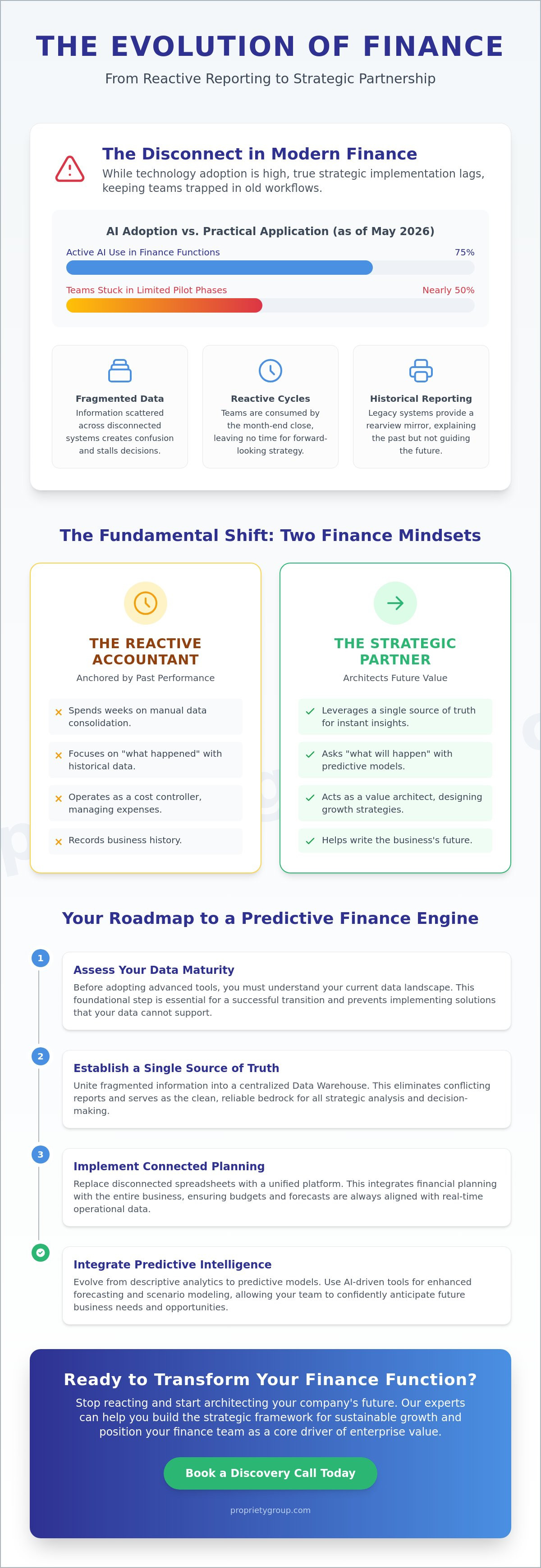
Did you know that as of May 2026, active AI use in the finance function has more than doubled to 75%, yet nearly half of teams remain stuck in limited pilot phases? It's a significant gap between technological potential and daily reality. Most finance leaders recognize the exhaustion of managing fragmented data across disconnected systems while developing a strategic finance function that actually performs. You likely feel the pressure of a month-end close that consumes the very time you should spend on high-level strategy. It's difficult to provide foresight when you're anchored by the weight of historical reporting.
You deserve a system built with the same precision and intentionality you bring to your fiscal oversight. This article provides a visionary framework to help you transition your team into a proactive, predictive engine that drives long-term organizational value. We'll explore how to establish a single source of truth and implement the forecasting capabilities necessary to act as a true partner to the business.
Key Takeaways
- Discover how to shift your team's focus from historical reporting to forward-looking insights that anticipate future business needs.
- Understand how modern performance management software serves as the foundation for uniting fragmented data into one reliable source.
- Identify the critical steps for developing a strategic finance function that positions your department as a core driver of enterprise value.
- Learn why assessing your current data maturity is essential before adopting advanced predictive tools and automated workflows.
- Explore the journey from initial analysis to the successful integration of intelligence that enhances forecasting and scenario modeling.
The Transition from Reactive Accounting to Strategic Business Partnership
The traditional role of the finance department often mirrors a rearview mirror; it tells you where you've been but offers little guidance on the road ahead. Today, the process of developing a strategic finance function requires a fundamental pivot from "what happened" to "what will happen." This isn't merely a change in reporting frequency. It's a complete reimagining of the department's purpose. In 2026, economic volatility and rapid market shifts have made reactive planning a significant liability for growing firms. Leaders now expect their CFOs to act as architects of value who design growth strategies rather than just controllers who manage costs.
Legacy systems often keep teams trapped in a cycle of data cleanup. When information is scattered across different platforms, the finance function remains a reactive reporting unit. A visionary approach prioritizes the intentional alignment of data and strategy, ensuring that every number serves a larger organizational goal.
To better understand this concept, watch this helpful video:
Moving Beyond the Traditional Finance Close
Manual data consolidation remains the primary barrier to high-level thinking. When your team spends weeks piecing together fragmented reports from traditional business management software that handles daily accounting and operations, they've little energy left for analysis. These older platforms were designed for recording transactions, not for the agile demands of modern growth. Establishing a single source of truth is the only way to eliminate the conflicting reports that often stall decision-making across different departments. Refining the Modern Financial Close Process creates the operational space needed for deeper insight, allowing you to move from processing transactions to providing strategic advisory.
The Strategic Finance Mindset
Success requires moving from descriptive analytics, which simply explain the past, to predictive models that anticipate the future. This evolution allows leadership to make intentional investments with absolute confidence. By embracing Strategic financial management, you ensure that every financial decision aligns with the long-term vision of the enterprise. Developing a strategic finance function means your team doesn't just record the business's history; they help write its future. It's about creating a culture where data drives action rather than just observation.
Constructing the Technical Foundation: Performance Management, AI, and Integrated Intelligence
A visionary framework requires more than a change in mindset; it demands a robust technical architecture. When developing a strategic finance function, the most common hurdle isn't a lack of talent but a lack of unified data. Information often sits in disconnected buckets, making it impossible to see the full picture. A centralized Data Warehouse serves as the essential bedrock for this transformation. It gathers disparate streams into a single, clean reservoir. This structural clarity allows a high-performing finance team to stop hunting for numbers and start interpreting them.
Modern finance leaders understand that technology shouldn't just record transactions. It should bridge the gap between financial planning and how the business actually runs. By connecting these areas, you ensure that every dollar spent on operating costs is directly tied to a strategic outcome. This creates a culture of accountability and precision that manual processes simply can't match.
The Power of Connected Planning
Unified platforms replace the chaos of disconnected spreadsheets with real-time forecasting. This shift ensures that financial planning isn't an isolated exercise but is deeply integrated with the entire business. Professional performance management advisory helps align these software tools with your unique business objectives, ensuring the technology serves the strategy. By incorporating Financial AI Solutions, your team can automate trend detection and identify patterns that human eyes might overlook.
Scenario Modelling and Stress Testing
True resilience comes from the ability to simulate the unknown. Modern performance management software allows you to conduct rigorous stress testing against market shifts or internal changes like workforce planning. Rather than reacting to a crisis, you can prepare a Management Actions Library of pre-vetted responses for various financial outcomes. This level of preparation turns uncertainty into a manageable variable. If you're ready to explore how these tools fit your specific needs, you might consider speaking with an expert about your technical roadmap.
Navigating the Implementation: From Initial Analysis to Sustainable Excellence
Developing a strategic finance function isn't a one-time event; it's a continuous evolution that requires a clear-eyed assessment of your current environment. Before selecting a solution, you must evaluate the readiness of your data and identify any outdated technology issues that might hinder progress. If the underlying information is fragmented, even the most sophisticated tools will struggle to provide clarity. Successful implementation requires more than just technical setup. It involves a deliberate journey of configuration, moving information between systems, and thoughtful user adoption. Propriety Group Services acts as a dedicated partner throughout this process, ensuring your technical roadmap aligns with your long-term vision for growth.
The First 90 Days of Transformation
The initial phase of transformation focuses on building momentum through "quick wins." By identifying and automating specific, time-consuming tasks, you can demonstrate immediate value to stakeholders and gain their buy-in for broader changes. This period is also critical for re-skilling the finance team. The objective is to transition them away from manual data entry and toward a role where they interpret data to provide actionable advice. When your team sees the power of real-time insights, the cultural shift toward a strategic mindset happens naturally.
Ensuring Long-Term Security and Precision
Precision is the cornerstone of trust in financial reporting. As you automate more processes, maintaining high standards of correctness and ethics becomes even more vital. A visionary framework doesn't just set a system in motion and walk away. It requires managed support, such as PG CARE, to continuously optimize performance and ensure the platform evolves alongside the business. This ongoing attention prevents system stagnation and ensures your finance function remains a proactive engine of value. To begin your journey toward a more predictive and authoritative finance department, book a call with our team today.
Designing Your Future Financial Landscape
The journey toward a modern finance department is an intentional act of design. It requires moving beyond the limitations of historical reporting to embrace a future defined by predictive clarity and unified data. By establishing a robust technical foundation and following a disciplined implementation roadmap, you transform your team into a core driver of enterprise value. Developing a strategic finance function isn't just about adopting new software; it's about aligning your technological architecture with a high-level vision for growth.
As a boutique consultancy specializing in EPM and CRM integration, we provide the expertise needed to navigate this transition with precision. Our focus on AI-driven financial intelligence ensures your team stays ahead of market shifts, while our PG Care managed support model provides long-term reliability and system optimization. You don't have to manage this complex transformation alone. To begin your journey toward a more visionary finance function, book a call with our expert advisory team today. With the right partnership and a clear framework, you can build a finance function that creates enduring value for years to come.
Frequently Asked Questions
How does strategic finance differ from traditional FP&A?
Strategic finance focuses on long-term value and forward-looking partnership, whereas traditional FP&A often centers on historical reporting and budgeting cycles. While traditional planning looks at what happened, strategic finance asks "what if" and "what next" to guide enterprise strategy. This shift integrates financial data with operational goals, transforming the team into a proactive business advisor that shapes the future rather than just recording the past.
What are the first steps in developing a strategic finance function?
The first step in developing a strategic finance function is conducting a thorough environment analysis to assess your current data maturity. You must identify where information is fragmented and determine the technical debt holding your team back from deeper analysis. Once you establish a clean data foundation, you can move toward implementing unified performance management tools. This structural clarity allows your team to shift their focus from manual data consolidation to high-value strategic advisory.
Can mid-sized organisations afford a strategic finance transformation?
Mid-sized organizations can achieve transformation by prioritizing scalable solutions that offer the highest immediate impact. Modern software implementation is no longer reserved for only the largest enterprises; it's an essential investment for any business seeking sustainable growth. By focusing on automation and utilizing managed support models like PG CARE, smaller teams can access the same predictive power as global corporations. This approach ensures you build a sophisticated function that grows alongside your business requirements.
How does AI improve the accuracy of financial forecasting?
AI enhances forecasting accuracy by automating trend detection and identifying complex patterns within vast datasets that human analysis might miss. These Financial AI Solutions allow for real-time scenario modeling and more precise stress testing against market volatility. Instead of relying on static spreadsheets, your team can use intelligent algorithms to generate dynamic, data-driven predictions. This technology reduces human bias and provides a more reliable basis for making critical investment decisions.
To begin your journey toward a more visionary finance function, book a call with our expert advisory team today.