
Intercompany Reconciliation: A Strategic Guide to Streamlining Your Financial Close

What if the meticulous precision required for your organisation's financial integrity didn't demand the exhaustive manual labour currently hindering your month-end progress? For many UK finance leaders, the reality is far less elegant; a 2023 report by Deloitte indicated that nearly 50% of finance teams still struggle with manual intercompany reconciliation processes that lead to reporting delays. You've likely felt the frustration of mismatched balances and the audit stress that follows. It's a drain on your most valuable resources.
We believe that financial excellence is the bedrock of a lasting corporate legacy. This guide shows you how to transform intercompany reconciliation from a tedious burden into a streamlined, automated pillar of your financial close. We'll explore how to establish a single source of truth that reduces manual entry, secures your data's integrity, and delivers a faster, more purposeful month-end for your entire group.
Key Takeaways
- Understand the essential principles of aligning internal accounts to ensure every transaction between your subsidiaries balances with absolute precision during the final consolidation.
- Implement a meticulous four-step framework designed to identify, match, and resolve discrepancies, bringing a new level of integrity to your group reporting.
- Discover why establishing standardised policies across all branches is the cornerstone of maintaining data consistency and a seamless financial close.
- Explore how transitioning from manual burdens to automated intercompany reconciliation empowers your finance team to focus on high-value strategic initiatives.
- Learn how to integrate modern software into your broader financial strategy to create a more resilient and transparent reporting legacy for your organisation.
What is Intercompany Reconciliation and Why is it Essential?
At its core, intercompany reconciliation involves the meticulous matching of transactions between different branches or subsidiaries of the same parent organisation. This process ensures that internal payables and receivables cancel each other out perfectly during the consolidation of group accounts. Within the broader framework of intercompany accounting, it serves as the primary mechanism for maintaining fiscal integrity. By establishing a single source of truth, leaders can make strategic decisions with absolute certainty.
To better understand this concept, watch this helpful video:
Accurate financial reporting relies on this foundation. Without it, the group balance sheet remains distorted, which can lead to regulatory scrutiny. In the UK, compliance with Financial Reporting Standards requires a level of precision that manual methods often fail to reach. It is not merely about balancing books; it is about protecting the company legacy through transparency.
The True Cost of Fragmented Financial Data
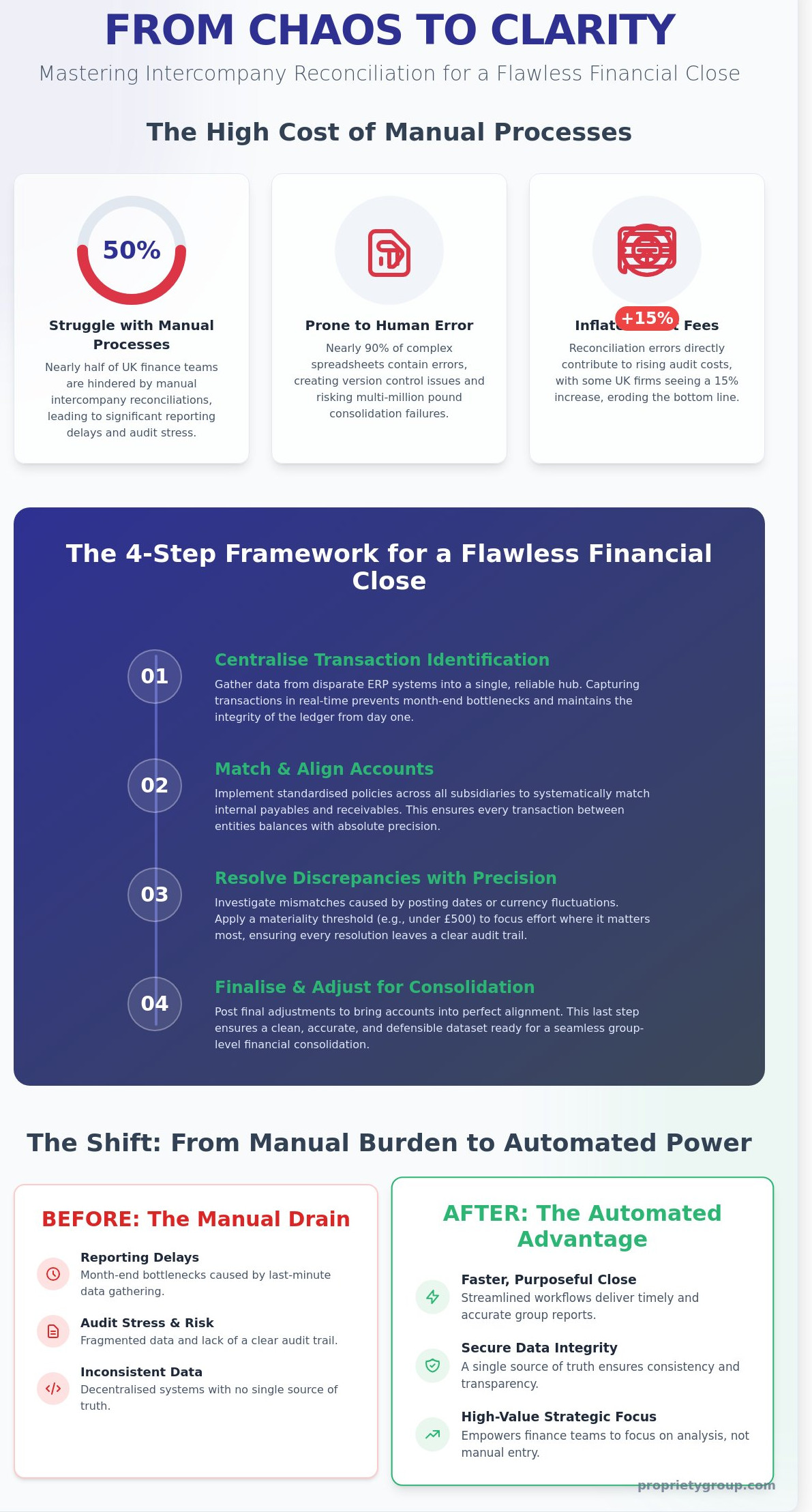
Reliance on manual processes creates hidden expenses that erode a firm's bottom line. Beyond the obvious drain on staff time, fragmented data often results in inflated audit fees. In 2023, some UK firms reported a 15% increase in audit costs specifically due to reconciliation errors. Timing differences and currency fluctuations across international borders further obscure group-level visibility, making it difficult to track liquid assets in real time.
Common Obstacles in Multi-Entity Environments
Managing multiple entities brings the challenge of decentralised systems. When different regions use inconsistent data entry methods, the risk of error grows. Spreadsheet fatigue is a genuine threat to reporting accuracy. Recent industry data suggests that nearly 90% of complex spreadsheets contain errors. Relying on static documents leads to version control issues, where a single typo can derail a multi-million pound consolidation. This lack of synchronisation prevents a holistic view of the company's purpose and performance.
How to Organise an Effective Intercompany Reconciliation Process
An effective intercompany reconciliation process demands a foundation of absolute clarity and shared standards. Without a unified policy across all subsidiaries, data becomes fragmented, leading to significant delays during the close. A robust framework consists of four distinct stages: identification, matching, resolution, and final adjustment. This structure ensures that every transaction is accounted for before the books are closed. Intercompany agreements act as the governing law for these internal dealings, setting clear rules that prevent confusion. By implementing these standards, 85% of mid-sized UK firms report a smoother transition into their consolidated reporting cycles. It's about creating a legacy of accuracy that stands up to the most rigorous scrutiny.
Step 1: Centralising Transaction Identification
Efficiency begins with gathering data from various ERP systems into a single, reliable hub. Waiting for month-end to review transactions creates a bottleneck that often results in overlooked errors. Capturing transactions in real-time allows teams to spot issues as they happen. This proactive approach maintains the integrity of the ledger and reduces the stress of the final week. For a deeper look at how these stages function in practice, you might explore this Intercompany Reconciliation Process and Examples guide, which details the logistical flow of data. Centralisation ensures that every stakeholder views the same version of the truth, regardless of their location.
Step 2: Resolving Discrepancies with Precision
Mismatches often stem from inconsistent posting dates or fluctuating exchange rates between the pound and foreign currencies. Teams must investigate these gaps with a meticulous eye, but they should also apply a materiality threshold. If a discrepancy is under £500, for instance, the cost of investigation might outweigh the benefit of the correction. Every resolution must leave a clear audit trail to ensure transparency and long-term security. Establishing such bespoke financial controls ensures your organisation maintains its reputation for precision and ethical conduct. This disciplined approach to resolution prevents small errors from compounding into significant financial risks over time.
Moving Towards Automated Financial Consolidation
Automation isn't a replacement for human talent. It's an invitation for finance teams to focus on strategy and foresight. By removing the burden of manual entry, professionals can dedicate their time to the meticulous analysis that drives growth. This shift is central to the modern financial consolidation software ecosystem. It creates a connected environment where data moves between entities without friction. A 2023 report by Deloitte highlights that high-performing teams spend 48% less time on basic data tasks than their peers. Implementing automated intercompany reconciliation turns the traditional month-end sprint into a calm, continuous process that provides real-time clarity.
The Role of EPM Advisory in Transformation
Expert EPM advisory helps organisations build systems that prevent errors before they manifest. Instead of spending weeks fixing discrepancies in the ledger, teams adopt a proactive stance. This predictive approach ensures that financial reporting is a source of confidence, not a cause for concern. It's about designing a bespoke architecture that supports predictive growth while maintaining the highest standards of integrity.
Selecting the Right Tools for Your Organisation
Selecting tools requires a focus on permanence and precision. Leaders should evaluate software based on its ability to scale as the business expands across the UK and beyond. For those using established systems like PeopleSoft, it's often beneficial to explore specialized automation providers; you can learn more about PS WebSolution in this area. The best technology only succeeds when it's built on a foundation of purpose and clear communication.
- Prioritise systems that integrate seamlessly with current ERP architecture.
- Look for platforms that champion data integrity as a core value.
- Ensure the technology aligns with your long-term cultural goals and operational needs.
The right solution makes intercompany reconciliation a background task. This allows your people to pursue the visionary work that defines a lasting legacy. When data flows naturally, the finance department transforms from a cost centre into a strategic engine for the entire group.
Securing Your Financial Legacy
Mastering the month-end process requires more than just balancing books; it demands a shift towards precision and long-term clarity. Moving away from fragmented spreadsheets helps your finance team eliminate the friction that often slows down growth. A refined approach to intercompany reconciliation transforms a routine administrative task into a strategic asset. It ensures your data remains accurate, reliable, and ready for scrutiny. This clarity is essential for any organisation looking to maintain its integrity in an evolving market.
Propriety Group brings a visionary perspective to this transition. We're specialists in EPM and CRM software implementation, guiding organisations through the complexities of finance transformation with quiet confidence. Our bespoke PG Care support model provides the meticulous attention your systems need to maintain their health for years to come. This authoritative advisory is led by finance transformation experts who understand that true excellence is built on a foundation of purpose. It's about creating a system that serves your people and secures your professional legacy.
Begin your journey towards a connected, automated financial close with Propriety Group
With the right partnership, a seamless and transparent financial future is well within your reach.
Frequently Asked Questions
What is the difference between intercompany reconciliation and elimination?
Reconciliation is the process of verifying that two branches of a business agree on their shared transactions, whereas elimination is the final step of removing these internal entries from the group's total accounts. During intercompany reconciliation, you perform the essential groundwork to ensure both sets of records match perfectly. Elimination then ensures the company doesn't report profit from selling to itself, which is a requirement under UK accounting standards.
How often should intercompany reconciliation be performed?
You should perform these checks daily or weekly to prevent errors from building up before the month-end close. Although 65% of UK finance teams still wait until the end of the month, moving to a continuous model reduces the stress during the final reporting period. This proactive method allows your team to resolve mismatches immediately, ensuring the financial integrity of the organisation stays intact throughout the entire year.
Can intercompany reconciliation be fully automated?
Software can handle approximately 95% of the matching process, but human expertise is still necessary to resolve complex or unique exceptions. Modern tools for intercompany reconciliation use specific rules to pair thousands of transactions in seconds, which drastically cuts down on manual data entry. However, a skilled professional must still review the remaining 5% of unmatched items to ensure total accuracy and maintain Propriety Group's high standards.
What are the most common causes of intercompany discrepancies?
Discrepancies usually stem from currency exchange fluctuations and timing differences between various business units. For example, if one business unit records a £5,000 transaction on the 30th of September but a corresponding branch doesn't log it until the 1st of October, the books won't align. Data from a 2023 industry report indicates that manual data entry errors cause 40% of these mismatches, which underlines the importance of using precise systems.