
Automating CapEx Planning and Approval: A Strategic Guide for Finance Leaders

What if your capital allocation process functioned as a catalyst for growth rather than a hurdle to overcome? The transition to automating capex planning and approval is often the defining moment when a finance department moves from administrative oversight to strategic leadership. You've likely dealt with the quiet frustration of projects lingering in opaque approval chains or the risk of budgeting errors buried deep within a spreadsheet. Without real-time visibility into your capital commitments, maintaining a clear, visionary path for the organization remains a significant challenge.
This guide demonstrates how to transform capital expenditure from a manual bottleneck into a streamlined, data-driven discipline that mirrors your strategic vision. You'll discover how a centralized system creates a single source of truth, ensuring that every pound invested is an intentional step toward your firm's future. We'll examine the path toward faster approval cycles and the sophisticated alignment of your capital spending with long-term strategic goals. To begin refining your financial architecture, we invite you to book a call with our team.
Key Takeaways
- Transitioning from fragmented spreadsheets to a unified digital environment is essential for maintaining a precise and transparent view of your organization's true investment health.
- Discover how automating capex planning and approval eliminates manual delays by establishing a seamless, end-to-end lifecycle for every capital project.
- Connected planning ensures that each capital request automatically informs your cash flow and balance sheet forecasts, providing immediate clarity on future financial commitments.
- Learn why integrating capital strategy into a broader Enterprise Performance Management (EPM) framework provides the strategic depth that isolated, standalone tools simply cannot match.
- Transform your capital expenditure from a manual bottleneck into a data-driven discipline that reflects your long-term vision; book a call with our team to start this journey.
The Strategic Necessity of Automating Capital Expenditure
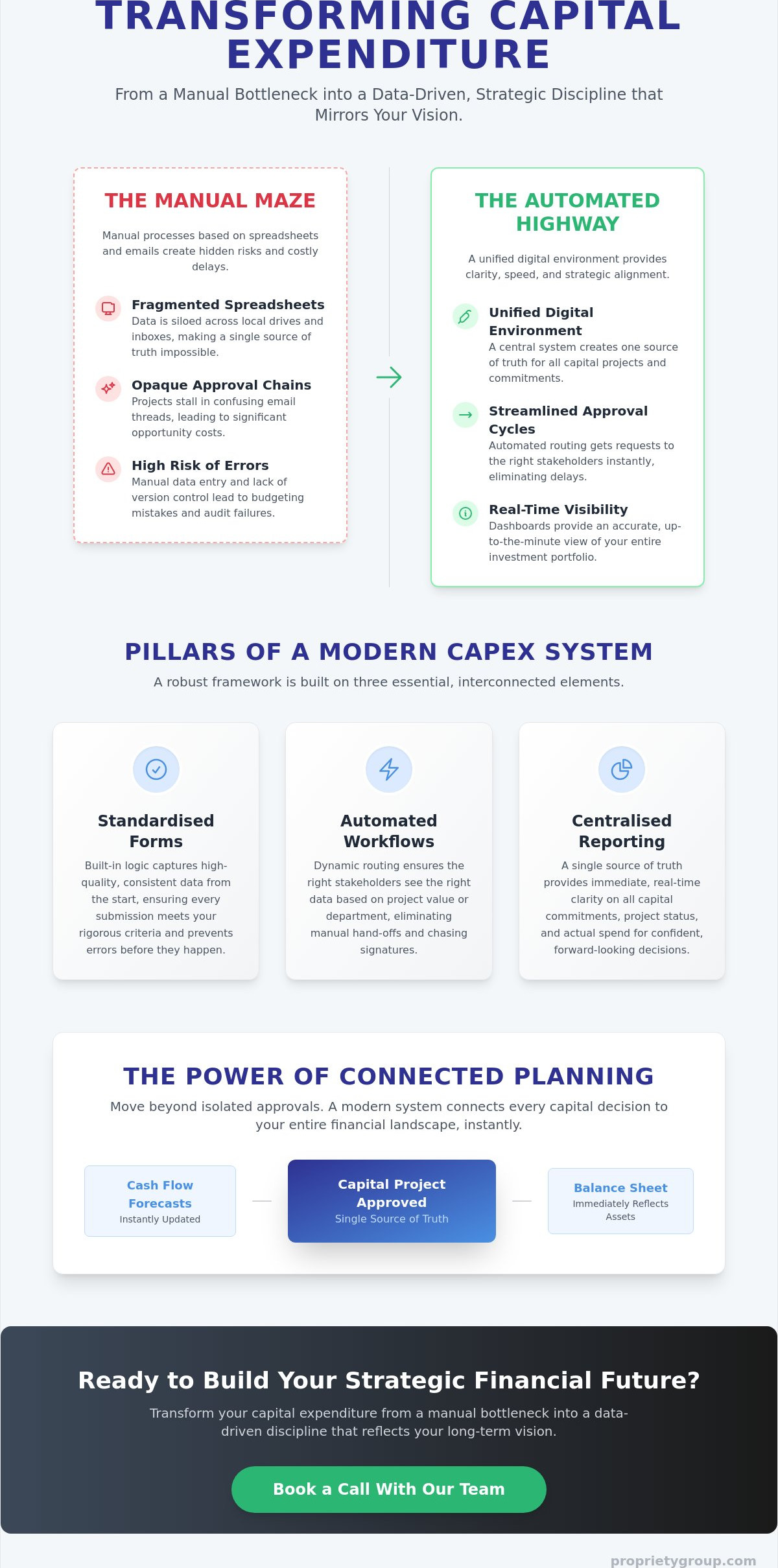
Automating capex planning and approval represents a fundamental shift in how organizations manage their physical and digital assets. It's the transition from a world of siloed spreadsheets and disconnected emails to a unified digital environment. Manual processes do more than just delay a single project. They obscure the true health of your entire investment portfolio, making it difficult to see where capital is actually working.
To better understand how these workflows function in practice, watch this helpful demonstration:
True strategic stewardship requires leadership to focus on long-term value rather than the administrative burden of chasing signatures. When capital is trapped in inefficient approval cycles, the organization faces a significant opportunity cost. Projects that could drive growth remain on hold while resources are consumed by the friction of the process itself. Effective capital budgeting requires a level of precision that manual systems simply cannot provide.
The Hidden Costs of Manual Approval Workflows
Manual workflows often hide their true cost within the fragmentation of data. When requests live in personal inboxes or local drives, the organization loses its collective memory. This lack of transparency creates a significant governance risk. Inconsistent documentation and a lack of clear version control often lead to audit failures and a breakdown in accountability. It's impossible to maintain standards of correctness when the data itself is scattered across the business.
Moving Toward Forward-Looking Decision Making
The goal of automation is to move from simply reporting on what happened to predicting what should happen next. Instead of looking in the rearview mirror, finance leaders can use real-time data to model future scenarios. Our EPM Advisory services create the foundation for this shift, helping you build a framework that supports both current operations and future aspirations. By aligning human experience with intentional spending, you create enduring value for the entire enterprise. To explore how this transformation applies to your organization, book a call with our team.
Designing a Modern Automated CapEx Lifecycle
A modern CapEx lifecycle is much more than a sequence of digital signatures. It's a continuous, intentional loop that begins with initial prioritisation and concludes with a thorough post-investment review. By automating capex planning and approval, you ensure that every project proposal is evaluated against its potential for enduring value. This structured approach is the cornerstone of effective capital budgeting decisions, allowing your team to move with speed while maintaining absolute precision.
Many organisations treat capital spending as an isolated island, separate from daily operations. However, true financial maturity lies in "Connected Planning." When you approve a project, the system should immediately reflect those commitments in your cash flow and balance sheet forecasts. It's about seeing how a new facility today impacts your workforce planning and operating expenses tomorrow. Real-time validation ensures that every pound committed is accurately accounted for at the point of entry, preventing errors before they ever reach the month-end close.
The Pillars of a Robust CapEx System
Building a reliable system requires a focus on standards of correctness and transparency. A sophisticated framework relies on these essential elements:
- Standardised Request Forms: Built-in logic captures high-quality data from the start, ensuring every submission meets your rigorous criteria.
- Automated Approval Chains: Dynamic routing ensures the right stakeholders see the right data based on project value or department, eliminating manual rework.
- Centralised Reporting: A single source of truth provides immediate clarity on all capital commitments and actual spend.
Integrating AI and Predictive Analytics
Advanced Financial AI Solutions now allow leaders to look beyond simple data entry. These tools can identify subtle trends in project spending and predict potential overruns long before they occur. Scenario modelling is equally vital. It lets you test "what-if" situations, such as shifting interest rates or supply chain delays, before you commit significant funds. If you're ready to design a more resilient financial framework, you might consider how to align your strategy with our implementation expertise.
Implementing Automation through EPM: From Vision to Execution
Standalone software tools often promise a rapid fix but frequently fail to address the underlying complexities of a true finance transformation. These isolated applications lack the strategic breadth required to integrate capital planning with your broader financial ecosystem, often creating new data silos instead of dissolving them. At Propriety Group, we prioritize a thorough environment analysis. This ensures the technology aligns with your unique organizational culture and existing workflows before any implementation begins. It's about creating a system that feels like a natural extension of your leadership style.
Choosing the correct EPM Platform is a decision that dictates your long-term scalability and institutional resilience. You aren't just buying software; you're building a foundation that must grow alongside your aspirations. Once the implementation is complete, the transition to ongoing support is managed through models like PG Care. This ensures your system remains optimized and continues to reflect your standards of correctness as the business landscape evolves.
The Role of Expert Advisory in Finance Transformation
Many organizations fall into the trap of a technology-first approach, which often results in fragmented reporting and low user adoption. Expert advisory bridges this gap by ensuring the tools serve the strategy, not the other way around. Through bespoke workshops and strategic consultancy, we ensure that automating capex planning and approval serves the CFO’s broader vision. This principled approach ensures that every digital workflow is anchored in intentionality and ethical governance.
Ensuring Long-Term Precision and Reliability
Maintaining a high-performance planning environment requires more than a successful launch. It demands ongoing training and system optimization to ensure long-term precision and reliability. We advocate for a measured, steady flow that moves from high-level strategic concepts to the granular details of execution. This creates a sense of thoroughness and transparency that instills trust in your data. It’s time to move toward a more intentional and secure financial future. To begin this transformation, we invite you to book a call with our team.
Mastering the Future of Capital Stewardship
Transforming your capital expenditure from a manual burden into a streamlined discipline allows your leadership team to reclaim its focus on long-term value. By establishing a single source of truth and connecting your capital projects to your broader financial forecasts, you create a foundation of reliability and trust. It's about ensuring that every investment decision is backed by real-time data and aligned with your broader strategic goals. Transitioning toward automating capex planning and approval represents a significant step in this evolution, replacing opaque approval chains with a transparent, high-performance environment.
Our approach combines expert advisory for EPM with the integration of predictive AI and analytics to ensure your system is both visionary and precise. Through bespoke implementation and ongoing PG Care support, we help you maintain a standard of excellence that scales with your organization. To explore how your organization can achieve greater precision in capital planning, book a call with the Propriety Group team today. We look forward to helping you build a more intentional and secure financial future.
Frequently Asked Questions
What are the primary benefits of automating the CapEx approval process?
The primary benefits include accelerated project timelines and a significant reduction in administrative friction. By removing manual barriers, finance teams can shift their focus from tracking down paperwork to analyzing the long-term value of their investments. This transition ensures that capital is deployed where it can generate the greatest impact, fostering a culture of proactive growth rather than reactive spending. It's about creating a streamlined path from a project's inception to its final execution.
How does CapEx automation improve financial governance and audit trails?
Automating capex planning and approval strengthens governance by creating an immutable digital record of every request and decision. This centralized approach ensures that all documentation is consistent and easily accessible during internal or external audits. It eliminates the risk of lost emails or unrecorded verbal approvals, providing a clear map of accountability. Such transparency instills a sense of trust and security among stakeholders, as every expenditure is justified by a verifiable and permanent audit trail.
Can automated CapEx planning integrate with our existing ERP and EPM systems?
Modern automation solutions are designed to integrate seamlessly with your existing ERP and EPM environments. This connectivity ensures that data flows effortlessly between systems, preventing information silos that lead to budgeting errors. By linking capital requests directly to core financial systems, you maintain a single source of truth across the enterprise. This integration is vital for maintaining standards of correctness and ensuring every department operates with the same real-time insights.
What is the difference between a standalone CapEx tool and a connected EPM solution?
A standalone tool typically focuses on the narrow task of workflow routing, while a connected EPM solution integrates capital planning into your entire financial strategy. Standalone options often fail to account for how capital spending impacts areas like workforce planning. A connected approach provides a holistic view, allowing you to see the ripple effects of every investment across the balance sheet. This perspective is essential for leaders who view financial management as an act of intentional stewardship.
To explore how your organization can achieve greater precision in capital planning and ensure long-term financial security, book a call with our team today.