
Capital Expenditure Planning Process: A Strategic Framework for Finance Leaders in 2026

What if your capital expenditure planning process was not a hurdle of manual data entry, but the architectural blueprint for your organization's future value? In a year where the prime interest rate hovers between 7.5% and 8%, the margin for error in asset acquisition has never been thinner. You likely recognize the frustration of managing competing departmental requests without a clear view of their long-term impact. It's a common struggle to balance immediate operational needs with the precision required for lasting corporate growth.
This article promises to help you transform fragmented tracking into a disciplined, forward-looking process that aligns every investment with your strategic vision. You'll discover how to leverage permanent tax provisions, such as 100% bonus depreciation and the $2.5 million Section 179 limit, to maximize your first-year expensing. We will also outline a standardized workflow that replaces manual errors with real-time visibility into project returns. We'll explore the alignment of finance and operational leadership through modern software solutions. To learn how to implement these frameworks, book a call with our team today.
Key Takeaways
- Redefine your capital expenditure planning process as a deliberate blueprint for value. It's time to move beyond the simple tracking of expenses and toward a system that builds enduring worth.
- Establish a standardized workflow to ensure every asset request is evaluated with precision. This disciplined approach ensures that each investment aligns perfectly with your long-term corporate vision.
- Integrate your capital plans with operating expenses and workforce data to create a unified view of your organization. Transparency in these connections is vital for maintaining financial security and prestige.
- Leverage financial AI solutions to predict the long-term return on investment for your most significant projects. Precise forecasting transforms uncertainty into a position of quiet confidence.
- Book a call with our team today to learn how to build a more disciplined and transparent framework for your capital requests.
The Architecture of a Modern Capital Expenditure Planning Process
A refined capital expenditure planning process is more than a simple budget exercise; it's the architectural blueprint for an organization's future value. This framework serves as the systematic method for evaluating and funding long-term physical and digital assets. In 2026, the hallmark of visionary leadership is a definitive shift from "maintenance" spend to "transformational" investment. This means moving beyond just keeping the lights on and toward assets that reshape the business's competitive standing.
Maintaining liquidity while pursuing aggressive growth requires a structured approach that guards against over-extension. This is why EPM advisory has become a cornerstone for modern finance teams. It places Capital expenditure (CapEx) within a broader strategic lens, ensuring that every major purchase, from industrial machinery to advanced software, is synchronized with the company's overall financial health and ethical standards.
To better understand the distinction between capital and operational costs, watch this helpful video:
Why Traditional Spreadsheets Fail the Modern CFO
Relying on manual spreadsheets creates a version control nightmare that obscures your true financial position. When you're planning for multi-year, multi-million pound projects, fragmented data becomes a liability. A single error in a cell can ripple through years of forecasts, leading to poor decisions based on incorrect assumptions. A sophisticated capital expenditure planning process replaces these fragile files with a single, reliable source of truth that offers the precision required for high-level decision-making.
Strategic Alignment: The 'Why' Behind the Investment
Every capital request must be framed against the organization's primary strategic objectives to ensure resources aren't lost in departmental silos. This discipline ensures that investments serve the collective mission rather than isolated interests. Strategic alignment is the bridge between financial constraints and visionary goals. To discover how a structured framework can improve your investment outcomes, book a call with our team today.
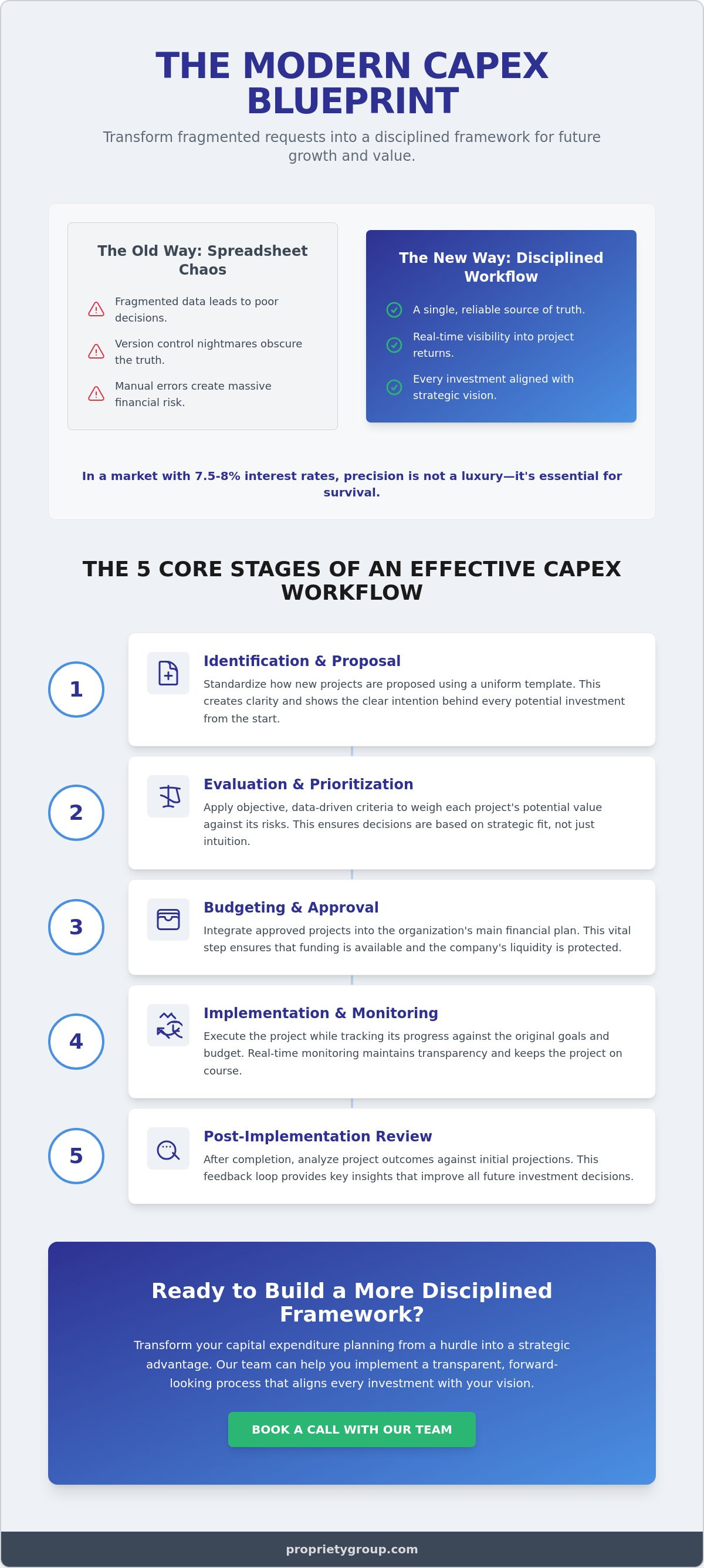
The Five Core Stages of an Effective CapEx Workflow
A disciplined workflow ensures that capital is deployed with surgical precision rather than intuition. This capital expenditure planning process begins with standardizing how departments propose their visions for growth. By using a uniform template for Stage 1: Identification and Proposal, you eliminate the ambiguity of fragmented requests. This clarity allows leadership to see the intentionality behind every potential investment from the outset.
Stage 2 focuses on Evaluation and Prioritisation. Here, you apply objective criteria to weigh the projected value against the risk profile of each project. Citing a comprehensive Capital Expenditure Planning Process guide can help ground these internal standards in established business value. Once projects are ranked, Stage 3 involves Budgeting and Approval. This step integrates the chosen investments into the wider planning and budgeting cycle, ensuring liquidity is preserved. Finally, Stage 4 covers Implementation and Monitoring, where you track progress against the original business case to maintain transparency.
Establishing Objective Selection Criteria
Moving beyond a "gut feeling" requires a scoring system that every stakeholder understands. By involving cross-functional teams, you ensure that a project's technical feasibility is as thoroughly vetted as its financial return. This collaborative approach builds trust across the organization, as every department sees that decisions are made based on merit and strategic fit rather than internal politics. It's a method that prioritizes permanence and long-term security over short-term gains.
The Post-Implementation Review: Closing the Loop
The final, often overlooked stage is the post-implementation review. Roughly 12 months after a project is completed, you should evaluate whether it actually met its intended goals. This feedback loop is essential for refining the accuracy of your future capital expenditure planning process. It reveals where assumptions were correct and where they fell short, providing the granular details needed to improve execution in the next cycle. If you're looking to refine your own framework, you can book a call with our team to discuss a more tailored approach.
Transitioning to Predictive CapEx Intelligence
Modern finance leaders recognize that a capital expenditure planning process cannot exist in a vacuum. To achieve true foresight, organizations are adopting "Connected Planning." This approach links your capital requests directly with operating expenses and headcount data within a single, coherent system. When these elements are unified, you gain a holistic understanding of how a new facility or a fleet of vehicles impacts your long-term liquidity and staffing needs.
Integrating financial AI solutions allows you to move from reactive tracking to proactive forecasting. These tools analyze historical performance and market trends to predict the long-term return on your most significant assets. This real-time visibility empowers the CFO to pivot and reallocate capital as market conditions shift, ensuring that resources are always directed toward the highest-value opportunities. A robust EPM platform serves as the single source of truth for this entire investment lifecycle, providing the transparency required for ethical and principled governance.
Harnessing AI for Predictive Maintenance and Planning
Predictive models offer a sophisticated way to anticipate when physical assets will require replacement or significant upgrades. By analyzing usage patterns and wear, you can schedule investments well in advance, effectively eliminating the need for costly "emergency" spending that disrupts your financial stability. AI reduces forecasting variance in multi-year capital projects by identifying subtle risk factors that manual analysis often overlooks.
Building a Forward-Looking Finance Function
Your capital expenditure planning process should be viewed as an evolving asset rather than a static policy. As your business grows and the economic landscape changes, your framework must adapt to maintain its precision and relevance. This commitment to continuous refinement ensures that your financial architecture remains a source of enduring value. To ensure your planning process is built for permanence and precision, book a call with our advisory team today.
Architecting the Future of Corporate Value
A refined capital expenditure planning process is the foundation of a resilient enterprise. You've seen how a structured architecture and standardized workflow transform capital from a mere cost into a strategic asset. By integrating predictive intelligence and connected planning, you ensure that every investment serves your long-term corporate vision with absolute clarity. This approach doesn't just track spend; it builds a legacy of financial precision and intentionality.
At Propriety Group, we bring deep expertise in EPM and CRM implementation to help you achieve this visionary transformation. Our bespoke PG Care support model provides the continuous reliability and expert-led narrative required for high-level decision-making. We invite you to book a call with our strategic advisory team to refine your planning process. Together, we can build a finance function that prioritizes craftsmanship and permanence in every investment. We look forward to helping you shape a secure and prosperous future for your organization.
Frequently Asked Questions
What is the difference between CapEx and OpEx planning?
CapEx planning manages investments in assets that provide value for years, while OpEx planning covers immediate, daily running costs. Think of CapEx as the permanent structure of your business and OpEx as the energy required to keep it functioning. A structured capital expenditure planning process ensures that your most significant financial commitments align with your long-term vision. This distinction is essential for maintaining liquidity while pursuing prestigious, transformational growth.
How often should an organisation review its capital expenditure plan?
You should ideally review your capital expenditure plan on a quarterly basis to maintain strategic alignment. This steady rhythm allows you to adjust to market shifts, such as the prime interest rate fluctuations seen in early 2026. Regular assessments ensure that your investments continue to reflect your corporate values and ethical standards. By treating your plan as a living document, you provide your leadership team with the thoroughness and transparency needed for long-term security.
What are the biggest risks in a manual CapEx planning process?
The primary risks include manual entry errors and a fragmented view of project returns across different departments. These flaws often lead to version control issues that obscure the true cost of multi-year, multi-million pound investments. Without a unified capital expenditure planning process, it's difficult to prioritize competing requests with the precision required for excellence. Moving away from spreadsheets reduces these risks, replacing guesswork with a principled and authoritative framework for decision-making.
How can AI improve the accuracy of capital investment forecasts?
AI enhances forecasting by analyzing historical data to predict the future performance and maintenance needs of your assets. These predictive models identify patterns that human analysis might miss, significantly reducing variance in long-term project budgets. This level of precision allows for more intentional planning, helping you avoid the disruption of unexpected equipment failures or cost overruns. It's a visionary approach that turns complex data into a reliable source of institutional trust.
To learn how to build a more disciplined and transparent framework for your capital investments, book a call with the team today.