

The traditional spreadsheet is no longer a tool for strategic leadership; it's a monument to yesterday’s data. When 80% of finance leaders surveyed by Gartner in 2023 state that AI will be essential for financial planning by 2026, the shift toward ai cash flow forecasting becomes a matter of institutional integrity rather than a mere technological upgrade. You likely recognize the quiet frustration that stems from fragmented data and the meticulous hours your team spends on manual entry. It's difficult to maintain a sense of prestige when your decision-making relies on reactive reporting that struggles to keep pace with the modern UK market.
This guide demonstrates how to transition to a proactive, AI-driven strategy that secures your organisation’s financial legacy. By adopting a more visionary approach, you can achieve real-time visibility into your future cash positions and empower your finance team to focus on high-level strategy. We'll explore the precise steps to automate your reporting and build a bespoke framework for confident scenario planning, ensuring your business remains steady through any period of market volatility.
Key Takeaways
- Shift your perspective from reactive accounting to predictive finance, allowing your leadership to anticipate future liquidity needs with meticulous precision.
- Discover the strategic framework for centralising your data, creating a unified environment that serves as a foundation for reliable financial planning.
- Learn how to integrate ai cash flow forecasting to identify the key business drivers that influence your cash movements, ensuring every decision is informed by foresight.
- Empower your leadership team with a single source of truth, fostering a culture of transparency and confidence through real-time visibility of your financial position.
- Secure the long-term legacy of your organisation by making informed investment and debt management decisions tailored to the unique conditions of the UK market.
Moving Beyond Manual Spreadsheets to AI-Driven Predictive Intelligence
For years, finance teams focused on the past. Traditional cash flow forecasting typically involved manual data entry into static spreadsheets. This method tells you what happened last month. It doesn't tell you what's coming. AI cash flow forecasting represents a fundamental shift. It uses your historical transaction data and combines it with external drivers like UK inflation rates or market trends. This system predicts future liquidity with a level of precision that manual methods can't match. To better understand how these tools transform financial management, watch this helpful video: Adopting ai in finance creates a forward-looking culture. Leaders move from reactive accounting to proactive strategy. Static spreadsheets are rigid and fragile. AI-driven models are dynamic. They update automatically as new information arrives. If a client delays a £50,000 payment, the model adjusts your entire outlook instantly. This ensures your strategic decisions are based on real-time reality rather than outdated assumptions.The Limitations of Fragmented Financial Reporting
Siloed data creates blind spots that hide risks. When financial information is trapped in different departments, you lose a single version of the truth. Manual consolidation is slow and risky. Research suggests that nearly 90% of complex spreadsheets contain errors. For a UK business, even a small mistake in a VAT calculation or payroll forecast can damage leadership confidence. It makes long-term planning feel like guesswork instead of a meticulous strategy.
Defining Predictive Intelligence for Modern Finance
Predictive intelligence is pattern recognition at scale. Machine learning sounds complex, but it's simply a tool that identifies trends across thousands of data points. It spots seasonal dips or payment delays before they become problems. AI isn't here to replace human expertise. It's a meticulous tool that enhances professional judgement. It allows you to focus on high-level strategy while the technology handles the granular details of execution with total integrity.
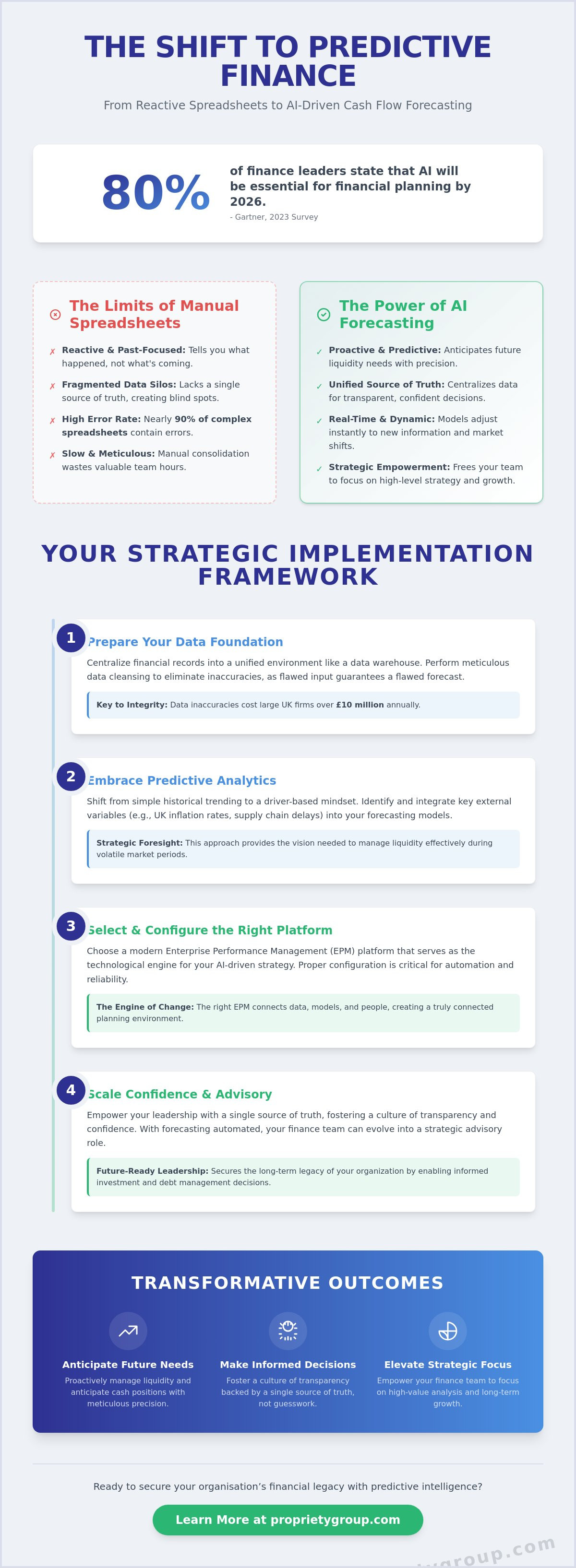
Implementing AI Cash Flow Forecasting: A Strategic Step-by-Step Framework
Moving from manual spreadsheets to ai cash flow forecasting requires a deliberate, four-stage approach. It's a transition that replaces guesswork with bespoke precision, ensuring your financial leadership remains proactive rather than reactive. This framework prioritises long-term stability over short-term fixes.
Preparing Your Data Foundation for AI Integration
Centralising your financial records into a unified environment is the essential starting point. Understanding what is a data warehouse allows a CFO to appreciate how a single source of truth eliminates discrepancies across the organisation. Meticulous data cleansing is the next priority. If the input is flawed, the forecast will be too. A 2023 report indicated that data inaccuracies cost UK enterprises significant capital, often exceeding £10 million for larger firms. We prioritise integrity at every level to ensure your models remain accurate and reliable.
Understanding the Role of Predictive Analytics
Modern leadership demands a shift from simple historical trending to driver-based thinking. You should examine predictive analytics financial planning models that factor in external variables like interest rate shifts or supply chain delays. Oracle notes that Predictive Cash Forecasting provides the foresight needed to manage liquidity during volatile periods. Identifying these key business drivers ensures your inflows and outflows are viewed through a strategic lens that accounts for the nuances of the UK market.
Selecting and configuring the right epm platform serves as the third step in this framework. The software must align with your specific operational needs rather than offering a generic solution. Finally, establish a human-in-the-loop process. This allows your senior team to validate AI outputs and refine models based on nuanced market knowledge and professional intuition. If you're ready to enhance your oversight, you might explore our advisory services to see how we align technology with your long-term goals.
Scaling Financial Confidence through Connected EPM and Advisory
True financial leadership requires more than just modern software; it demands a unified vision. Connected Enterprise Performance Management (EPM) solutions serve as a single source of truth for the entire leadership group. This alignment removes the friction of conflicting data, allowing directors to move from reactive accounting to proactive strategy. When every stakeholder sees the same real-time data, trust becomes the foundation of the boardroom.
Real-time visibility transforms how you manage capital. You can make investment decisions with certainty or adjust debt management strategies before market shifts become liabilities. For instance, if a UK lender adjusts interest rates, your system calculates the impact on a £5 million credit facility instantly. This level of precision is only possible through advanced ai cash flow forecasting. We believe technical implementation must be paired with bespoke advisory. A system is only as strong as the strategy behind it. Our PG Care model provides the meticulous, ongoing support needed to maintain system precision and adapt to new fiscal realities.
Scenario Modelling and Stress Testing for Future Security
AI allows finance teams to run complex what-if scenarios in seconds. Historically, testing the impact of a 12% increase in energy costs or a sudden supply chain delay might've taken a week of manual spreadsheet work. Now, it happens instantly. Stress testing your cash position against high market volatility ensures your legacy remains secure. You'll know exactly how much liquidity is required to weather a downturn or seize a sudden acquisition opportunity without compromising your stability.
The Importance of Addressing Bias in AI
Relying on algorithms requires a commitment to ethics. You should understand the risks of bias in ai to ensure your projections remain objective and reliable. Human oversight isn't just a safety net; it's a mark of professional propriety. Propriety Group acts as your strategic partner, ensuring your ai cash flow forecasting models remain accurate, ethical, and aligned with your long-term goals. We prioritise integrity in every calculation to protect your firm's reputation and financial health.
Charting a Course for Enduring Financial Precision
Transitioning from manual spreadsheets to ai cash flow forecasting represents a fundamental shift in how UK finance leaders protect their capital. By adopting a structured implementation framework, firms move from reactive accounting to proactive leadership. This evolution ensures that liquidity remains a source of strength rather than a point of vulnerability. A 2023 report by the ICAEW highlights that 74 percent of UK businesses now prioritise digital transformation, reflecting a market that values speed and accuracy above all else.
Propriety Group brings a design-led approach to this transition, ensuring your financial systems are as elegant as they are functional. Our bespoke EPM implementation expertise and the PG Care managed support model provide the long-term security necessary for sustainable growth. We focus on creating a legacy of integrity through connected advisory services that look beyond the next quarter. It's about building a foundation that lasts for decades, not just the next reporting cycle. Your vision for a more resilient future starts with the right architecture today.
Explore our bespoke financial AI solutions and secure your firm's predictive advantage.
Frequently Asked Questions
How accurate is AI cash flow forecasting compared to manual methods?
AI cash flow forecasting provides a level of precision that manual spreadsheets cannot match. While manual methods often result in a 20% variance due to human error, AI models reduce this margin to less than 5% by processing thousands of data points simultaneously. This meticulous approach ensures that financial leaders base their decisions on reliable, real-time insights rather than historical guesswork. It's a shift from reactive accounting to proactive strategy.
What data do I need to start using AI for cash flow predictions?
To begin, you require at least 24 months of historical transaction data and integrated access to your UK bank accounts. The system analyses your previous VAT payments, payroll cycles, and supplier invoices to identify recurring patterns. By combining this internal record with external market indicators, the AI creates a bespoke model of your financial future. This foundation allows for a transition from fragmented data to a unified, strategic vision.
Is AI cash flow forecasting suitable for mid-sized organisations or only large enterprises?
AI cash flow forecasting is highly effective for mid-sized organisations with annual turnovers between £10 million and £50 million. While large enterprises pioneered these tools, the democratisation of technology means smaller firms now use AI to manage complex supply chains and volatile interest rates. These organisations often see a 30% improvement in capital allocation efficiency. It's not a matter of scale, but a commitment to precision and long-term financial integrity.
How long does it typically take to implement an AI-driven forecasting solution?
A typical implementation follows a structured path of four to twelve weeks. The initial integration of your existing accounting software usually concludes within the first 14 days, followed by a period of model refinement and testing. By the end of the third month, most UK businesses achieve a fully operational system that delivers daily updates. This measured pace ensures that the transition is seamless, maintaining the propriety of your financial operations throughout the process.