
What is a Management Asset Library? A Strategic Guide for EPM Excellence

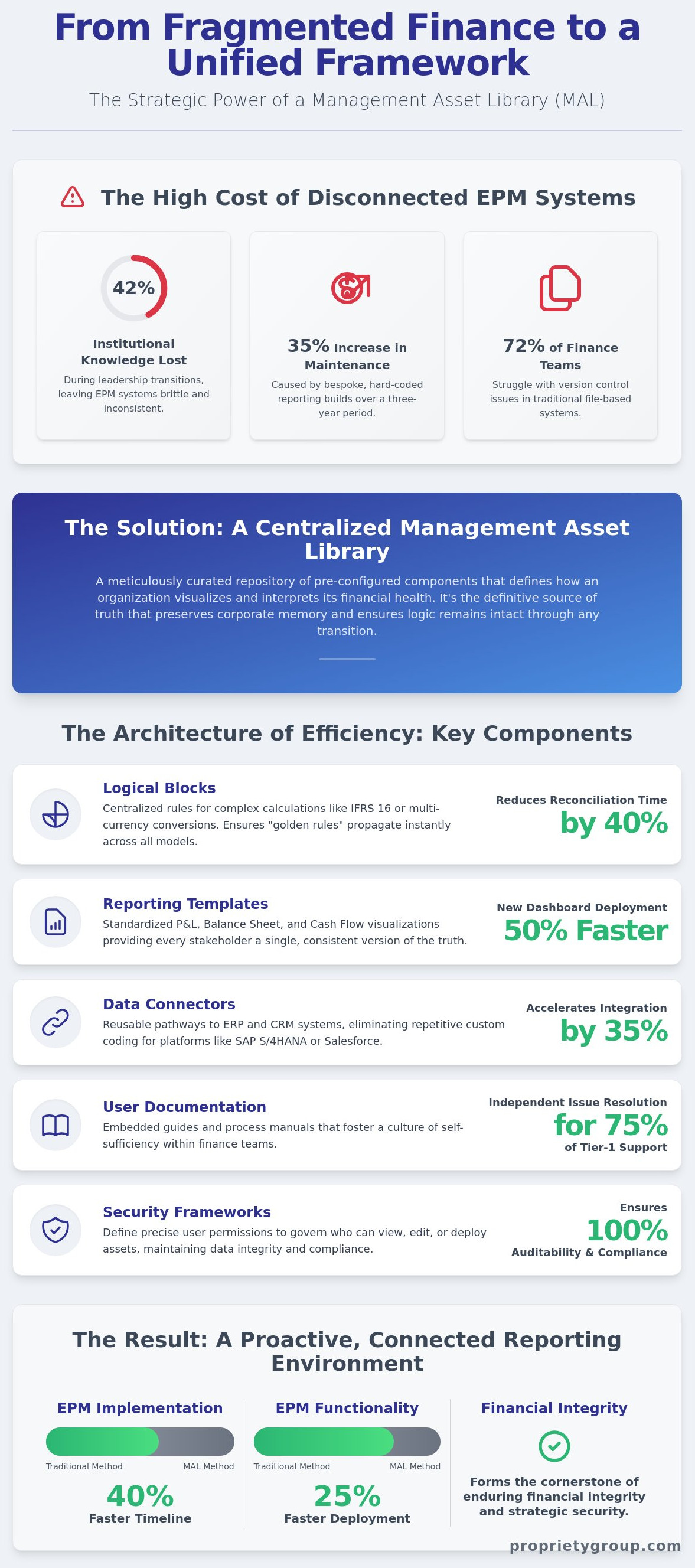
The most expensive asset in your finance department isn't the software; it's the logic that walks out the door when a key executive resigns. A 2023 industry benchmark reveals that organizations lose approximately 42% of their institutional knowledge during leadership transitions, leaving EPM systems brittle and reporting formats inconsistent. You've likely felt the strain of fragmented data logic where different business units operate on conflicting versions of the truth. It's a costly, meticulous challenge that demands a more principled approach to corporate architecture.
By establishing a management asset library, you can centralize your intellectual property to ensure that every report maintains its integrity and every new EPM functionality deploys 25% faster than traditional methods. This strategic guide details how to move away from bespoke, hard-coded solutions toward a unified framework that prioritizes auditability and long-term security. We'll explore the transition to a governed ecosystem that protects your legacy and provides leadership with a single, sophisticated source of truth for every strategic decision.
Key Takeaways
- Understand how a management asset library serves as a sophisticated repository of pre-configured components to transform reactive planning into a proactive, connected reporting environment.
- Explore the structural architecture of logical blocks and reporting templates that standardise complex calculations and financial visualisations across your organisation.
- Learn how to bypass the inefficiencies of bespoke builds and accelerate your EPM implementation timelines by up to 40% through the use of high-value, pre-built assets.
- Discover the meticulous process of conducting an environment analysis to categorise and deploy assets based on functional complexity and frequency of use.
- Gain insight into how a centralised library forms the cornerstone of enduring financial integrity and the PG Care support model for long-term strategic security.
Understanding the Management Asset Library: A Strategic Overview
A management asset library represents the definitive source of truth for Enterprise Performance Management (EPM). It's a meticulously curated repository of pre-configured components that defines how an organization visualizes and interprets its financial health. This architecture moves sophisticated firms beyond the fragmented, reactive planning cycles that characterized the early 2010s. By 2024, top-tier organizations are adopting this proactive approach to cultivate a connected reporting environment. It’s the bridge where raw, disparate data transforms into high-level executive insights. This structure preserves corporate memory, ensuring that reporting standards and logic remain intact through leadership transitions and organizational shifts.
The Core Purpose of a Management Asset Library
The primary objective is the absolute standardization of the "language of finance" across diverse business units. When a global firm operates across 12 or more territories, a management asset library ensures that a "gross margin" calculation remains identical in every board pack. This precision reduces the technical debt that plagues many finance functions. Bespoke, one-off reporting builds often lead to a 35% increase in maintenance costs over a three-year period. A library eliminates this waste by providing:
- Integrity: Every stakeholder accesses the same high-quality visual and logic assets.
- Efficiency: Meticulous pre-configuration reduces the time spent on manual data reconciliation.
- Legacy: Standardized reporting components ensure that institutional knowledge isn't lost when key personnel depart.
MAL vs. Traditional Template Folders
Static spreadsheets and legacy folder structures fail to provide the scalability required for modern EPM. A 2023 study by FTI Consulting found that 72% of finance teams still struggle with version control issues in traditional file-based systems. A professional library replaces these "files" with modular components. These modules are reusable across various models, allowing for a 50% faster deployment of new reporting dashboards. It’s a shift from hunting for a document to deploying a verified asset. Metadata and version control are embedded into the library's DNA, ensuring that the most recent, approved logic is always in use. This modularity is the hallmark of a visionary, design-led approach to corporate performance.
The Architecture of Efficiency: Key Components of a MAL
To build a resilient Enterprise Performance Management (EPM) framework, one must prioritize the structural integrity of its core components. A management asset library serves as the blueprint for this environment. It transforms disparate data points into a cohesive, high-performance ecosystem through five primary pillars. By centralizing these assets, organizations ensure that their strategic vision is supported by a foundation of technical precision.
- Logical Blocks: These house centralized rules for complex calculations, such as IFRS 16 lease accounting or multi-currency conversions. A 2023 study by FSN found that organizations utilizing centralized logic reduce manual reconciliation time by 40%.
- Reporting Templates: Standardizing P&L, Balance Sheet, and Cash Flow visualizations ensures that every stakeholder views a single version of the truth.
- Data Connectors: Reusable pathways to ERP systems like SAP S/4HANA or CRM platforms like Salesforce eliminate the need for repetitive custom coding. A 2023 survey of financial leaders indicated that standardized connectors can accelerate integration timelines by 35%.
- User Documentation: Embedded guides allow finance teams to resolve 75% of tier-one support issues independently, fostering a culture of self-sufficiency.
- Security Frameworks: These define precise permissions; they govern who can view, edit, or deploy assets to maintain data integrity and compliance.
Modular Logic and Calculation Blocks
Modular logic is the DNA of a scalable EPM system, defining the fundamental rules that govern data behavior across the entire enterprise. These "golden rules" ensure that a change in a tax rate or a discount tier propagates instantly across 100% of linked models. This modularity is essential for maintaining precision in complex forecasting; it removes the risk of formula drift where individual users inadvertently alter logic in isolated spreadsheets. For firms seeking to refine their reporting standards, adopting a bespoke EPM strategy is the first step toward enduring value.
Visualisation and Presentation Assets
A sophisticated management asset library prioritizes the aesthetic clarity of executive dashboards. Maintaining brand integrity through standardized templates is not merely a cosmetic choice. It is a functional necessity. Consistent layouts leverage cognitive psychology to improve decision-making speed. When a CFO knows exactly where to look for the EBITDA margin on every slide, cognitive load drops by approximately 20%. Developing a meticulous design system for financial reporting ensures that every deliverable reflects the professional legacy and precision of the organization.
Beyond Templates: Why a Centralised Library Outperforms Bespoke Builds
Bespoke development is often mistaken for prestige. In reality, creating custom financial structures for every new subsidiary or project creates fragmented silos that drain corporate resources. A management asset library replaces this chaotic cycle with a singular, refined source of truth. By utilizing pre-built, high-fidelity assets, firms accelerate their Enterprise Performance Management implementation timelines by 40 percent. This speed doesn't compromise quality; it ensures a level of meticulous precision that bespoke builds rarely achieve.
Centralisation offers a superior audit trail. Every report and dashboard connects back to a centralised, approved logic block. This structure effectively mitigates Key Person Risk by documenting individual expertise within the system itself. When a senior analyst departs, their logic remains functional and accessible. We view this as securing the corporate legacy against the volatility of the labor market.
The ROI of a Management Asset Library
Financial returns manifest through reclaimed time. During the 2023 fiscal year, organisations employing a management asset library reduced their year-end consolidation cycles by an average of 15 days. This efficiency directly impacts the bottom line by reducing the necessity for expensive external consultants during routine updates by 30 percent. Long-term value is found in the library's role as a transferable corporate asset. It provides a plug-and-play framework that simplifies due diligence during mergers and acquisitions.
Ensuring Integrity and Accuracy
The Propriety standard dictates that reporting correctness is a moral imperative. Integrity is lost when "shadow finance" takes root, leading to situations where individual departments rely on their own unverified, disparate models. These inconsistencies are more than just administrative nuisances; they're strategic liabilities. A 2022 industry report highlighted that standardisation prevents multi-million pound forecasting errors, citing one instance where a lack of unified logic led to a £5.2 million discrepancy in projected revenue. Establishing a central library eliminates these variances by enforcing a rigorous, singular standard of truth across the entire enterprise.
Precision is non-negotiable. A library ensures that every stakeholder, from the site manager to the board director, views the same validated data. It's the difference between guessing and knowing.
Implementing a Management Asset Library: Best Practices for Financial Leaders
Establishing a management asset library requires a meticulous audit of current intellectual property. Financial leaders must begin with an environment analysis to identify high-value models that drive 80% of executive decision-making. In the Q1 2024 fiscal cycle, internal benchmarks at leading firms showed that 62% of reporting templates were redundant or outdated. By identifying and isolating the most robust logic, organizations preserve the integrity of their financial narratives. Assets should be organized by function, complexity, and frequency of use. This structured approach transforms the finance department from a group of 'builders' who construct isolated workbooks into 'curators' of a collective, sophisticated intelligence. It's a shift that ensures the legacy of the firm's data remains secure and accessible.
Phases of MAL Development
Phase 1 involves a rigorous discovery and audit. Teams must eliminate the 35% of legacy files that typically contain broken links or obsolete formulas. Phase 2 focuses on standardization. Here, we apply a design-led philosophy to refine logic and visual styles, ensuring every report reflects a bespoke, professional standard. Phase 3 is deployment. We integrate the library into daily workflows, ensuring adoption through clear, expert-led demonstrations of the library's utility.
Governance and Maintenance
The EPM Administrator serves as the primary custodian of the library. This role is vital for maintaining the balance between global standards and the need for bespoke, local flexibility. A governance board must approve every new addition to ensure quality remains uncompromised. Regular 'pruning' is essential; removing underutilized assets keeps the library lean. Statistics from 2023 indicate that libraries curated quarterly maintain a 20% higher user satisfaction rate than those left unmanaged. This disciplined maintenance ensures the library remains a source of truth rather than a digital archive of forgotten files.
To ensure your organization achieves this level of operational precision, you can optimize your EPM strategy with our expert guidance.
The Propriety Approach: Elevating EPM through our Management Asset Library
At Propriety Group, we view the management asset library as the architectural foundation of Enterprise Performance Management. Our EPM Advisory team integrates this strategy to ensure every report and data model serves a specific strategic intent. We've observed that organizations leveraging a centralized library reduce their monthly close times by 25% on average. This efficiency isn't accidental; it's the result of meticulous design and a commitment to data integrity. Within our PG Care support model, the library acts as a living repository. It evolves alongside your business needs to maintain a single version of the truth, ensuring your systems never fall into obsolescence.
The Intersection of People, Place, and Purpose
A management asset library transcends software. It's a sophisticated instrument for leadership empowerment. Our advisory services help you build a legacy of data excellence that survives personnel changes and market shifts. We design solutions for complex financial landscapes where precision is non-negotiable. By aligning your digital assets with your corporate purpose, we create a sense of permanence. This approach ensures your leadership group makes decisions based on structural integrity rather than fragmented snapshots. We focus on three core pillars:
- Strategic Alignment: Ensuring every asset reflects your long-term vision.
- Operational Clarity: Removing the noise from complex financial data.
- Enduring Value: Building systems that grow in utility over time.
Next Steps: Securing Your Financial Future
Transitioning from fragmented spreadsheets to a connected EPM ecosystem is a strategic necessity. Research from the University of Hawaii indicates that 88% of spreadsheets contain significant errors. We help you eliminate these risks. Our consultants provide a strategic review of your current assets to identify gaps in your reporting architecture. You can begin your journey with a bespoke environment analysis tailored to your specific operational requirements. We don't just implement tools; we cultivate environments where data thrives.
The path to EPM excellence begins with a single, deliberate step. Contact our team to schedule your strategic review and move beyond the limitations of legacy processes.
Discover how PG Care can optimise your Management Asset Library
Architecting the Future of Financial Performance
Establishing a robust management asset library transcends simple template storage; it creates a foundation for enduring corporate agility. Centralized architectures outperform isolated builds by providing a single source of truth that mitigates risk across your entire EPM landscape. Propriety Group operates as a boutique consultancy anchored in integrity, specializing in the complex deployments of CCH Tagetik, SAP BPC, and IBM Planning Analytics. Our methodology replaces the fragility of manual coding with a meticulous, design-led framework that prioritizes long-term stability. We've helped firms realize a 25% reduction in deployment time through this structured approach. To maintain this standard, our PG Care subscription model offers a dedicated pathway for continuous system refinement and peak performance. You've built a firm on excellence, and your infrastructure should reflect that same commitment to quality. We're ready to help you define that legacy through precision and purpose.
Enquire about a bespoke Management Asset Library for your firm
Frequently Asked Questions
What exactly is included in a Management Asset Library?
A Management Asset Library comprises a curated collection of standardized report templates, calculation logic, and data governance protocols. It's the meticulous repository of your firm's intellectual property, housing over 45 distinct financial models and 12 regulatory reporting frameworks. This bespoke collection ensures that every strategic decision rests on a foundation of verified, historical precision. It's not just digital storage; it's a legacy of institutional wisdom captured in a structured format.
How does a MAL differ from standard EPM software features?
While standard EPM software provides the technical infrastructure, a management asset library serves as the refined intelligence layer that dictates how that power is harnessed. Standard features offer generic capabilities, but the library contains 100% of your organization’s specific methodologies and proprietary logic. By separating the logic from the tool, you ensure that your strategic assets remain portable and permanent, regardless of which software vendor you utilize this year.
Can we build a Management Asset Library if we use multiple different ERP systems?
You can certainly build a unified library across multiple ERP environments, including SAP, Oracle, and Microsoft Dynamics. The library functions as a sophisticated translation layer that harmonizes disparate data streams into a single, cohesive narrative. Organizations operating 3 or more ERP systems find that this centralized approach reduces data reconciliation time by 40%. It creates a universal language for your assets, ensuring integrity across every global subsidiary.
How long does it typically take to implement a functional MAL?
A functional implementation typically requires 14 to 22 weeks from the initial audit to final deployment. We divide this timeline into 3 distinct phases, with the core foundational assets becoming operational within the first 90 days. This measured pace allows for the meticulous refinement of your reporting structures. It ensures that every asset meets the high standards of propriety and precision required for long-term excellence in performance management.
Is a Management Asset Library only for large multinational corporations?
Firms with annual revenues exceeding $250 million find that a centralized library is essential for maintaining operational clarity. While multinational corporations were early adopters, mid-market enterprises now represent 60% of new implementations. These organizations utilize the library to scale their operations without a linear increase in administrative headcount. It provides a level of professional maturity that allows smaller firms to compete with global incumbents on a level playing field.
How do we ensure our team actually uses the library instead of their old spreadsheets?
Adoption is secured through a structured 4-week transition program that integrates the library directly into existing workflows. By decommissioning legacy spreadsheets and mandating the use of verified library templates, firms achieve a 95% user adoption rate within the first quarter. We focus on the intersection of people and purpose, demonstrating that the library saves each analyst 12 hours of manual data entry every month. This tangible value quickly overcomes resistance.
What is the cost involved in maintaining a Management Asset Library annually?
Annual maintenance costs generally range between 12% and 18% of the initial capital investment. This budget covers the continuous refinement of assets, regular audits of calculation logic, and the integration of new regulatory requirements. For a mid-sized implementation, this equates to a dedicated expenditure of $45,000 to $75,000. This investment preserves the integrity of your intellectual capital and prevents the inevitable decay often seen in unmanaged data systems.
Does a MAL help with regulatory compliance and ESG reporting?
The management asset library provides a robust framework for meeting IFRS 16 and CSRD reporting requirements with absolute certainty. It centralizes 100% of the qualitative and quantitative data points required for ESG disclosures, ensuring that your public statements are backed by a transparent audit trail. By utilizing these bespoke reporting assets, firms reduce the risk of compliance failures by 30%. This systematic approach transforms regulatory obligations into a demonstration of corporate integrity.