

The most expensive software in the world is worthless if your people remain tethered to manual spreadsheets out of a sense of fear or confusion. We often see organizations invest millions in technology only to face low adoption rates and fragmented reporting that undermines the original vision. Training finance teams on new epm system isn't merely a box to check during a technical rollout. It's a deliberate act of craftsmanship that aligns human intuition with digital precision. When you prioritize intentional team enablement, you don't just install a tool; you build a foundation for long-term security and excellence.
It's natural to feel a sense of anxiety as AI and automation begin to reshape traditional roles, especially with mandatory ESG reporting requirements like the CSRD now demanding your attention. You want a single source of truth that empowers your team rather than making them feel obsolete. This guide will show you how to transform your EPM implementation into a strategic advantage that fosters confident, forward-looking decision-making across your entire organization. We'll examine a framework for moving beyond legacy systems toward a future of predictive analytics and seamless cross-functional collaboration. To begin your journey toward a more sophisticated financial architecture, book a call with our team today.
Key Takeaways
- Recognize training as the vital bridge between software capability and executive intentionality to prevent fragmented reporting and user hesitation.
- Learn how to conduct a thorough environment analysis to determine the current technical readiness and data literacy of your finance department.
- Use a role-based curriculum when training finance teams on new epm system to ensure that every team member achieves high-level proficiency tailored to their responsibilities.
- Move beyond the "go-live" mindset by adopting a philosophy of permanence. This approach treats your performance management tools as living, evolving assets that require continuous refinement.
- Establish a single source of truth for your financial data and book a call with our team to start your journey toward predictive excellence.
The Strategic Imperative: Why Training is the Foundation of EPM Success
Software capability is only half the equation. Training finance teams on new epm system serves as the critical bridge between raw technical features and the intentionality of executive leadership. Without this alignment, even the most advanced platforms become expensive digital archives rather than active drivers of value. Excellence is found in the space where human intuition meets digital precision.
Fragmented reporting and data silos often persist after a rollout, but these issues rarely stem from system failure. Instead, they arise from a lack of user confidence. When teams don't trust the new interface, they often retreat to the familiar security of manual spreadsheets, which inevitably compromises the integrity of the data. This creates a cycle of inefficiency that undermines the entire investment and leaves leadership without the clarity they need.
To better understand how these systems function in a modern environment, watch this helpful overview:
Moving from reactive planning to proactive, AI-driven forecasting is more than a technical upgrade; it's a profound cultural change. This transition is essential as regulations like the CSRD make mandatory ESG reporting a reality for 2026, requiring teams to manage non-financial data with absolute rigor. Strategic Enablement is the process of empowering finance leaders to make forward-looking decisions with clarity and precision.
Moving Beyond Technical Instruction to Strategic Enablement
Standard tutorials often fail because they focus on which buttons to press rather than why those actions matter. We believe in value-driven workshops that emphasize business outcomes and situational framing. By helping your team understand the logic behind new data structures, you ensure the system is used with purpose and intent. This philosophy is central to our EPM Advisory approach, where we treat technology as a means to achieve broader strategic goals and long-term security. To ensure your team is prepared for the future of financial management, book a call with our team today.
Architecting a Training Framework for High-Performance Finance Teams
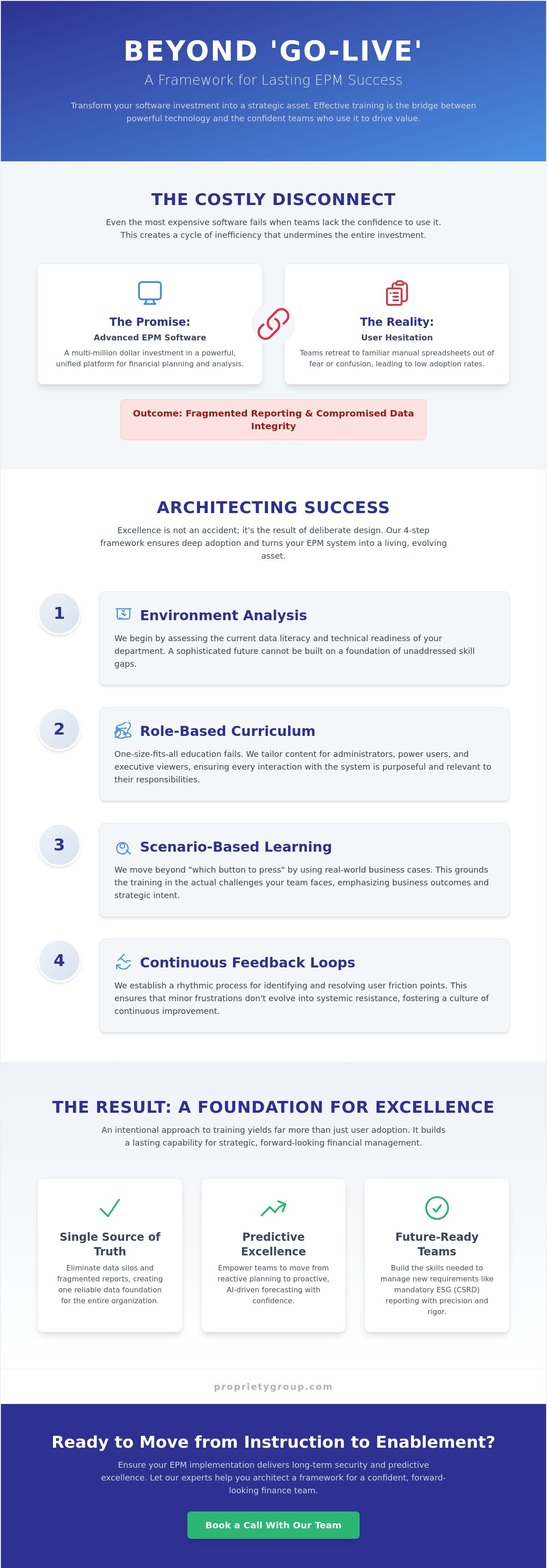
A successful rollout requires more than a standard instruction manual. It demands a structured architecture that respects the unique needs of every department member. When training finance teams on new epm system, we follow a four-step framework designed to ensure both immediate adoption and long-term security. Excellence isn't an accident; it's the result of deliberate design.
- Step 1: Environment Analysis. We begin by assessing the current data literacy and technical readiness of the department. It's impossible to build a sophisticated future on a foundation of unaddressed skill gaps.
- Step 2: Role-Based Curriculum Design. We don't believe in one-size-fits-all education. Instead, we tailor content for administrators, power users, and executive viewers to ensure every interaction with the system is purposeful.
- Step 3: Scenario-Based Learning. By using real-world business cases, such as Scenario Modelling for OPEX, we ground the training in the actual challenges your team faces daily.
- Step 4: Feedback Loops. We establish a rhythmic process for identifying and resolving user friction points. This ensures that minor frustrations don't evolve into systemic resistance.
If you feel your current approach lacks this level of precision, you may wish to discuss your framework with our advisors to ensure your implementation remains on track.
Aligning User Roles with System Intentionality
Precision starts at the top. We train CFOs to utilize executive dashboards for high-level decision-making, ensuring they can distill complex data into actionable insights instantly. Meanwhile, FP&A teams focus on mastering Financial AI Solutions to harness predictive intelligence and move beyond historical reporting. Throughout this process, we emphasize "standards of correctness" in every data entry task. This disciplined approach is the only way to maintain a Single Source of Truth, providing the clarity required for a seamless transition from legacy systems to a visionary, data-led future.
Ensuring Permanence: From Initial Adoption to Continuous Mastery
A common misconception in digital transformation is that training finance teams on new epm system is a one-time event that concludes at "go-live." This perspective often leads to a phenomenon known as knowledge decay. Without ongoing support, the initial proficiency of your team begins to erode, and users often retreat to the familiar but inefficient security of manual spreadsheets. True excellence requires a shift in mindset toward what we call the philosophy of Permanence.
We view an EPM system as a living, evolving asset rather than a static piece of software. It requires constant refinement to remain aligned with your business goals and the shifting regulatory landscape. As your long-term partner, we ensure that your technology doesn't just function, but thrives. By treating system mastery as a continuous journey, you protect your investment and maintain a foundation of long-term security.
The PG Care Model: Sustaining Precision Through Managed Support
Sustaining high performance demands a steady, communicative rhythm between your team and your technology. Our PG Care - EPM Solution Support model provides this essential continuity through a subscription-based approach. It moves beyond simple troubleshooting to offer proactive system optimization and bespoke workshops tailored to your specific needs. Through PG Care, we help you maintain the high standards of correctness that define a premium finance function.
This managed approach prevents technical friction from disrupting your strategic focus. It fosters an environment where human experience and physical digital space exist in perfect alignment, allowing your team to operate with absolute intentionality. When your people feel confident in their tools, they can focus on creating enduring value for the organization. To explore how we can support your journey toward continuous mastery, book a call with our team today.
Cultivating a Future of Financial Precision
The transformation of your financial architecture from a mere technical tool into a visionary strategic asset rests upon one foundational pillar. That pillar is the intentionality you bring to training finance teams on new epm system. We've explored how a role-based framework and a commitment to continuous mastery prevent the erosion of knowledge and the return to fragmented reporting. Success isn't found in the software alone; it's found in the confidence of the people who use it every day.
Our approach is rooted in an expert-led narrative that prioritizes CFO-level strategy and the alignment of human experience with digital precision. As specialists in SAP SAC, Board, and AI-driven finance transformation, we don't just implement tools; we create enduring value. Through our proprietary PG Care managed support model, we provide the steady rhythm and expertise required to sustain high-performance standards over the long term. This commitment to excellence ensures your system remains an evolving asset rather than a static relic.
It's time to move beyond the limitations of legacy processes and embrace a future of predictive intelligence. We invite you to book a call with our specialist advisory team to discuss your EPM training requirements. Together, we can build a culture of excellence that secures your organization's long-term growth and stability.
Frequently Asked Questions
How long does it typically take to train a finance team on a new EPM system?
Initial enablement typically spans four to eight weeks, depending on the complexity of your environment and the team's current technical readiness. This duration allows for a structured transition from foundational concepts to advanced scenario modeling. However, training finance teams on new epm system is an ongoing pursuit of mastery. True proficiency evolves over several months as the team integrates the system into their rhythmic reporting cycles and strategic workflows.
Can we conduct EPM training internally, or do we need an advisory partner?
While internal teams can manage basic functional instruction, a specialist advisory partner provides the strategic context and standards of correctness required for high-level decision-making. External experts bring a discerning perspective that aligns human intent with digital precision. An advisory partner also helps navigate complex transitions, such as mandatory ESG reporting, which requires a level of rigor and cross-functional collaboration that internal teams may not yet possess.
How do we handle resistance from team members who prefer traditional spreadsheets?
Resistance is usually a symptom of user anxiety regarding system complexity or role displacement. You can address this by shifting the focus from technical tutorials to value-driven workshops that highlight personal benefits, such as reduced manual error and faster closing cycles. By framing the new system as a tool for elevating their strategic influence rather than a replacement for their skills, you foster a sense of aspirational security.
What are the most important KPIs to track during the training and adoption phase?
You should prioritize metrics that reflect the actual alignment of human experience with the new platform. Key indicators include system login frequency, the reduction in time spent on manual data reconciliation, and the percentage of reports generated within the new environment. Tracking these KPIs ensures that training finance teams on new epm system leads to a single source of truth and a seamless transition from legacy workflows to predictive analytics. To refine your training strategy, book a call with our team today.