
The True Cost of Poor Financial Data: A Guide for Finance Leaders

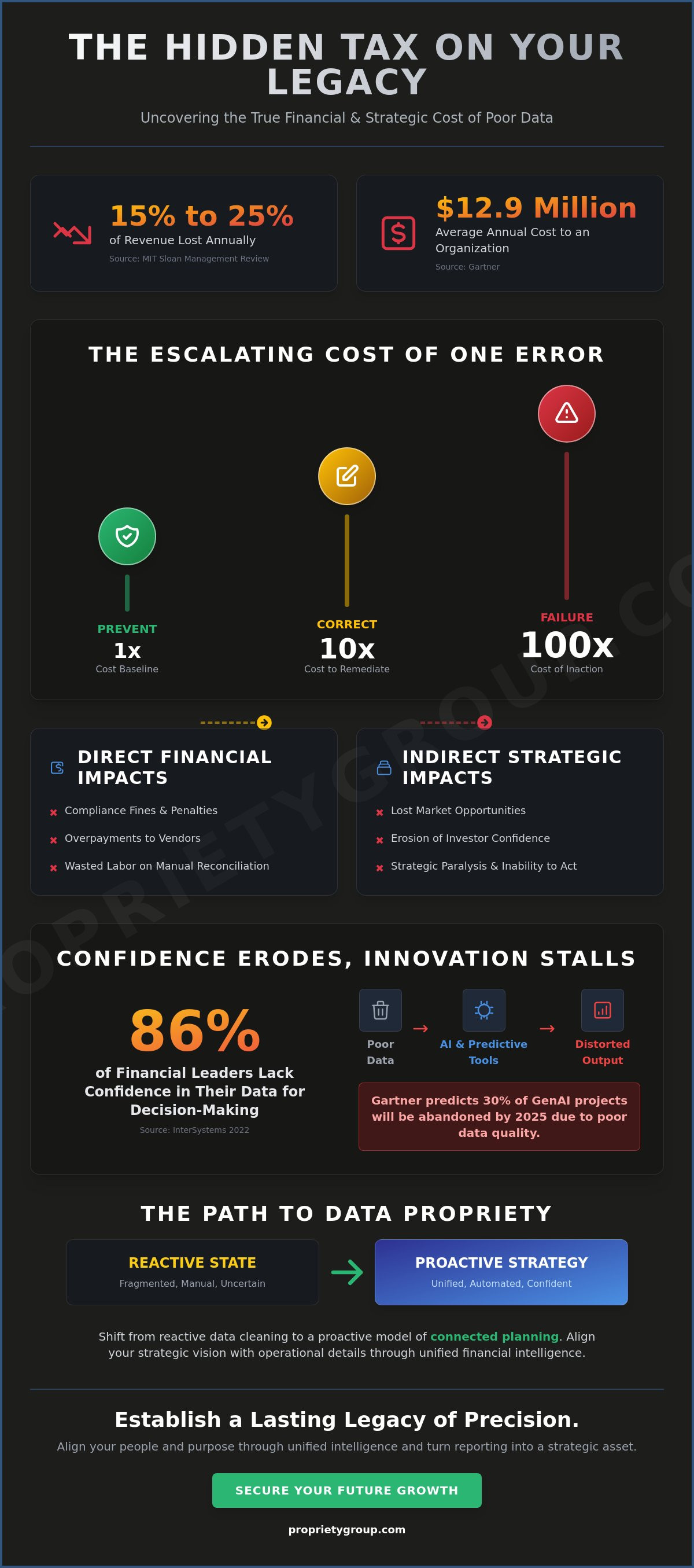
Research from the MIT Sloan Management Review suggests that the cost of poor financial data drains between 15% and 25% of a company's revenue every single year. For a sophisticated organization, this isn't just a technical oversight; it's a silent saboteur of your strategic legacy. You've likely experienced the tension of a board meeting where conflicting versions of the truth emerge, or felt the drain of a team spending hours on manual reconciliation. With Gartner estimating that poor data quality costs organizations an average of $12.9 million annually, the path forward requires more than just better software. It requires a meticulous commitment to data integrity.
We understand that true leadership depends on the clarity of your vision. This article will help you uncover the hidden financial impact of fragmented reporting and provide a bespoke roadmap to unified financial intelligence. You'll learn how to transform your data into a reliable asset that supports bold, forward-looking forecasts. By establishing a foundation of precision, you'll gain the confidence to use predictive tools and AI to secure your organization's future growth.
Key Takeaways
- Learn why preventing a single data error is ten times more efficient than correcting one after it enters your system. This simple principle protects your team's time and your firm's resources.
- Understand how the cost of poor financial data acts as a hidden tax on your margins by distorting your pricing strategies. Clear information ensures your profitability remains protected and visible.
- Discover why the success of your future AI initiatives depends on the integrity of your current information. Building on a clean foundation is the only way to ensure your predictive tools deliver reliable results.
- Shift your perspective from reactive data cleaning to a proactive model of connected planning. This approach aligns your strategic vision with the daily details of your operations.
- See how professional guidance helps you create a lasting legacy of precision. Aligning your people and purpose through unified intelligence turns your reporting into a strategic asset.
The Invisible Erosion: Identifying the Real Cost of Poor Financial Data
Poor financial data is far more than a simple clerical error. It's a fragmented and reactive state where information lives in isolated silos, creating inconsistencies that cloud your vision. When systems don't communicate, the result is a baseline of uncertainty that erodes the foundation of your strategic planning. Maintaining foundational Data quality standards is essential for any leader who values precision and long-term security.
To better understand this concept, watch this helpful video:
A core principle in meticulous data management is the "Rule of Ten." This concept suggests that it costs ten times more to correct a data error than it does to prevent one through proper governance. If that error is left unaddressed and leads to a strategic failure, the cost can escalate to one hundred times the original prevention price. This highlights the value of propriety; doing things correctly from the start is an investment in your company’s permanence.
The most immediate drain is on your most valuable asset: your people. Teams often spend hours on manual reconciliation, acting as human bridges between disconnected spreadsheets. This labor takes them away from high-level analysis, leading to a state of strategic paralysis. When 86% of financial leaders lack confidence in their data for decision-making, as reported by InterSystems in 2022, the ability to act with certainty disappears. The true cost of poor financial data is the loss of the ability to lead with quiet confidence.
Direct vs. Indirect Financial Impacts
The direct costs are often visible on the balance sheet through compliance fines, overpayments to vendors, or wasted labor costs. However, the indirect costs are more insidious. These manifest as lost market opportunities because you couldn't move fast enough, or the slow erosion of investor confidence when reports require constant revision. Data integrity is the foundation of corporate propriety, ensuring that every strategic move is built on a legacy of precision.
Strategic Consequences: How Flawed Data Undermines the CFO’s Vision
Flawed information acts as a silent pricing saboteur. When margin analysis is distorted by fragmented records, the company’s profitability erodes without a visible cause. This isn't a mere technical glitch; it's a direct threat to the CFO's strategic vision. Many leaders believe that implementing a standard ERP system creates a single source of truth. However, an ERP often lacks the flexibility to unify data from diverse operational arms, leaving gaps that slow down the Modern Financial Close Process and hinder agility.
The AI Paradox in Modern Finance
The current rush toward artificial intelligence creates a unique risk for those with compromised data foundations. Gartner predicts that 30% of generative AI projects will be abandoned by the end of 2025 due to poor data quality and weak governance. If you feed an algorithm inconsistent historical records, it will only amplify those errors at scale. To avoid this "garbage in, distorted output" cycle, leaders must prioritize Unified Financial Intelligence. Understanding the True Cost Of Bad Data is essential because high-fidelity historical data is the only fuel that makes predictive analytics effective.
Erosion of Leadership Confidence
Beyond the balance sheet, the cost of poor financial data manifests in the boardroom. When the CFO and the Board look at conflicting dashboards, friction replaces collaboration. This creates a culture of reactive firefighting where energy is spent defending numbers rather than exploring new horizons. Moving toward a model of propriety means replacing this uncertainty with a steady, expert-led narrative. If you're ready to move beyond fragmented reporting, exploring a bespoke strategic assessment can help align your people and purpose.
Establishing a Legacy of Integrity: The Path to Data Propriety
True financial leadership requires a shift from reactive data cleaning to a proactive philosophy of connected planning. While the cost of poor financial data can be measured in millions of dollars, the value of a meticulous system is found in the quiet certainty it provides for every strategic move. Establishing this foundation starts with EPM Advisory, a process designed to align your people and purpose with a standard of absolute correctness.
Maintaining this standard isn't a one-time project; it's a commitment to ongoing data health. Through a subscription-based support model like PG Care, your organization ensures that its financial intelligence remains precise as the business evolves. The ongoing cost of poor financial data is often the result of neglecting these foundational systems over time. Steady oversight prevents the slow decay of records and protects your long-term legacy from the hidden erosions of fragmented reporting.
Steps to Unified Financial Intelligence
- Step 1: Environment Analysis. We begin by identifying exactly where fragmentation occurs across your current systems to understand your unique challenges.
- Step 2: Platform Implementation. We implement a robust EPM platform to bridge the gap between your daily operations and high-level strategic reporting.
- Step 3: Meticulous Support. Ongoing care ensures your data stays reliable, allowing you to use AI and predictive tools with total confidence.
Choosing a Visionary Transformation Partner
Off-the-shelf software rarely addresses the unique complexities of a premium organization. A bespoke implementation is necessary because it respects the specific intersection of your operational needs and your financial ethics. When choosing the right EPM platform, you need a partner who views data as a means of creating enduring value rather than just a technical requirement. High-quality data isn't a luxury for the few; it's a principled standard of correctness that defines modern corporate propriety.
Securing Your Strategic Legacy Through Data Integrity
The journey toward unified intelligence begins with a single, principled decision. You've seen how the cost of poor financial data acts as a quiet drain on your organization's potential, clouding your vision and slowing your response to market shifts. By moving beyond fragmented spreadsheets and embracing a meticulous approach to reporting, you transform your finance function into a source of enduring value. True propriety in finance isn't just about accuracy; it's about creating a foundation where people, place, and purpose align perfectly.
As specialists in EPM and CRM software implementation, we provide the bespoke advisory finance teams need to navigate this transformation. Our subscription-based PG Care model ensures your systems remain healthy and reliable long after the initial setup. It's time to replace uncertainty with the quiet confidence of precision. Empower your leadership group with a bespoke EPM solution from Propriety Group and reclaim your ability to plan with absolute clarity. Your legacy of strategic growth starts today.
Frequently Asked Questions
What are the most common signs of poor financial data in an organisation?
The most visible signs include teams spending over 50% of their time on manual reconciliation and board meetings where different departments present conflicting numbers for the same metric. You might also notice your financial close process stretching beyond 10 days or a persistent lack of confidence in your three-year projections. These symptoms indicate that the cost of poor financial data is already eroding your team's productivity and strategic focus.
How does poor data quality specifically affect AI and machine learning in finance?
Poor data acts as a faulty foundation for AI, leading to inaccurate models that amplify and reinforce existing errors at scale. Since Gartner predicts that 30% of generative AI projects will be abandoned by the end of 2025 due to weak data governance, high-fidelity records are no longer optional. Without meticulous historical data, even the most expensive predictive tools cannot generate the reliable insights needed for secure growth.
Can software alone fix our financial data quality issues?
Software is a powerful tool, but it cannot solve data issues without a principled approach to your people and processes. Technology alone doesn't account for human error, which research identifies as a primary cause of fragmented records. A true transformation requires bespoke advisory to align your team's daily habits with a standard of correctness. This ensures your systems reflect a legacy of integrity rather than just a new digital interface.
What is the "Single Source of Truth" and why does it matter for CFOs?
A Single Source of Truth is a unified data environment where every stakeholder accesses the same, verified information in real time. It matters because it eliminates the friction of conflicting reports and allows the CFO to lead with quiet confidence. In an era where 86% of financial leaders lack confidence in their decision-making data, according to a 2022 InterSystems survey, this clarity is the only way to ensure long-term corporate propriety.