
Navigating Data Integrity Issues in Financial Reporting: A Guide for Finance Leaders

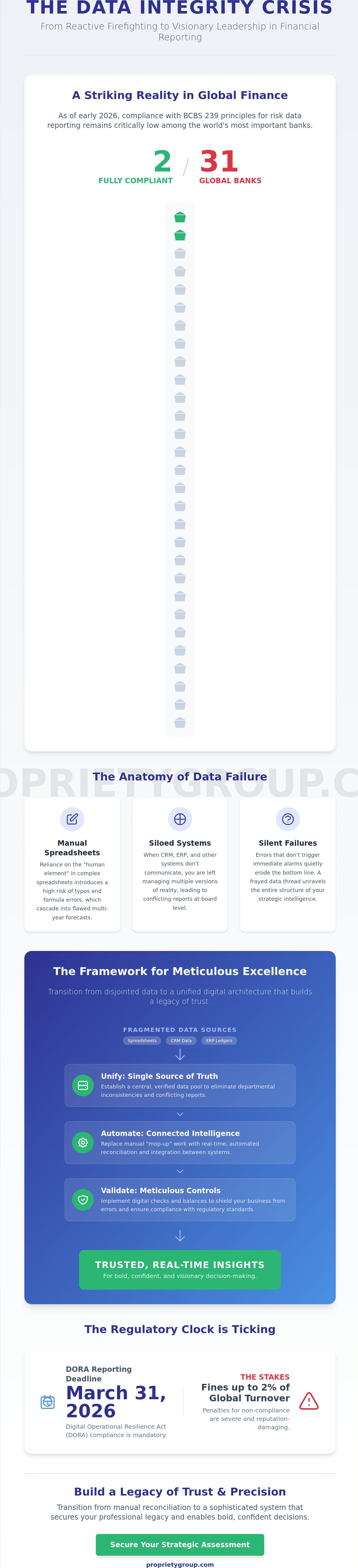
As of early 2026, only two of the 31 global systemically important banks have achieved full compliance with the BCBS 239 principles for risk data reporting. This striking reality highlights why data integrity issues in financial reporting remain a persistent challenge for even the most prestigious institutions. You've likely felt the frustration of watching a board meeting lose momentum because different departments presented conflicting numbers. It's difficult to maintain a sense of propriety and confidence when your team spends its best hours manually fixing spreadsheets instead of analyzing the future.
We believe that clarity is the prerequisite for visionary leadership. This guide will show you how to identify, resolve, and prevent data failures to build a foundation of trust and precision. You'll learn how to establish a single source of truth that provides real-time insights for your most critical decisions. We'll move from the granular details of automated reporting to the high-level strategic intelligence required to navigate the current regulatory environment, including the March 31, 2026, DORA reporting deadline. This is your path to creating a legacy of reliability and meticulous excellence.
Key Takeaways
- Learn how to view data as a meticulous lifecycle asset to move your team from reactive planning to forward-looking strategy.
- Discover the practical steps to resolve persistent data integrity issues in financial reporting by unifying fragmented information into a single digital environment.
- Understand how establishing a single source of truth eliminates departmental inconsistencies and restores trust in your board-level presentations.
- Explore how expert guidance helps you transition from manual spreadsheet reconciliation to a sophisticated system that secures your professional legacy.
- See how high-quality data serves as the essential foundation for using predictive tools to make bold, confident decisions for the future.
Understanding the Foundations of Data Integrity in Financial Reporting
Data integrity is more than a technical requirement; it's the meticulous preservation of accuracy and consistency across the entire lifecycle of your information. When we speak about the foundations of data integrity, we're describing the bedrock upon which corporate propriety is built. Without this stability, finance leaders find themselves trapped in a cycle of reactive planning. Instead of shaping the future with a visionary hand, they're forced to defend the past, constantly questioning if the numbers on the screen reflect the true state of the enterprise.
To visualize how these principles manifest in practice, watch this helpful video:
The most dangerous aspect of poor data is the "silent failure." These are errors that don't trigger immediate alarms but quietly erode the bottom line over months or years. While an isolated data point might seem harmless, a connected financial environment treats every figure as a vital thread in a larger tapestry. When one thread is frayed, the entire structure of your strategic intelligence begins to unravel. True excellence requires a holistic approach where data isn't just stored, but curated with a sense of purpose and permanence.
Common Triggers of Financial Data Inconsistency
Many data integrity issues in financial reporting stem from a reliance on the "human element" within complex, manual spreadsheets. A single typo in a growth assumption, for instance, can cascade into a flawed multi-year forecast that misguides capital allocation for an entire decade. This risk is amplified when systems remain siloed. If your customer relationship data doesn't communicate with your resource planning tools, you aren't just managing two systems; you're managing two different versions of reality. This lack of coordination prevents the steady, measured flow of information necessary for principled decision-making and long-term security.
A Strategic Framework for Restoring Data Accuracy
Solving data integrity issues in financial reporting requires a departure from the chaotic assembly of disjointed spreadsheets. Leaders must transition toward a unified digital architecture that treats every byte of information with the respect it deserves. This transformation begins by establishing a single source of truth for finance. When every department draws from the same pool of verified data, the friction of conflicting reports disappears. Automated reconciliation then replaces the exhausting "mop-up" work typically found at the end of the month. Instead of manual cross-checking, the system ensures balance in real time. Standardized governance rules act as a steady hand, ensuring that propriety is maintained across every office and subsidiary.
The Shift from Manual Processes to Connected Intelligence
Moving to connected intelligence starts with a thorough analysis of your current environment to find where data leaks or degrades. It's about more than just software; it's about the flow of information. Automated integration ensures that a change made in your sales system instantly updates your financial forecasts. This visibility is essential for meeting modern standards, such as the Digital Operational Resilience Act (DORA) requirements due by March 31, 2026. Real-time insights allow you to lead with a visionary perspective rather than looking in the rearview mirror at historical data that's already weeks old.
Implementing Meticulous Validation Controls
Meticulous validation controls serve as digital checks and balances within your financial systems. These automated safeguards are your best defense against data integrity issues in financial reporting, shielding your business from audit failures. They ensure that every submission meets precise standards, such as the xBRL-CSV format required for the 2026 DORA reporting cycle. Failing to implement these controls can lead to heavy penalties, including fines of up to 2% of a company's global turnover. If you're ready to refine your reporting foundations, consider how a bespoke strategic assessment can secure your long-term legacy.
Building a Legacy of Trust through EPM and AI
True leadership isn't just about managing numbers; it's about the principles behind them. Achieving long-term propriety requires more than a temporary fix for data integrity issues in financial reporting. It demands a commitment to excellence that transforms how your organization views its information. Engaging with EPM advisory provides the expertise needed to move beyond technical checkboxes. It ensures your data isn't just accurate today but remains a source of strategic intelligence for years to come.
The Role of Modern EPM Platforms
Success in this transformation depends on choosing the right EPM platform to serve as your digital foundation. A well-selected system eliminates the technical malfunctions that often lead to inconsistent numbers across different departments. At its core, this process honors the intersection of people, place, and purpose. It aligns your team's talent with a structured environment designed for meticulous precision. This harmony is what creates enduring value and a sense of quiet confidence during board meetings.
Predictive Growth and Financial AI
As we look toward the August 2, 2026, deadline for high-risk systems under the EU AI Act, the quality of your data becomes even more critical. The promise of AI in finance isn't a magic solution for poor record-keeping. It relies entirely on the integrity of the underlying information. When you view data as a strategic asset rather than a simple record, you unlock the ability to make confident, forward-looking decisions. Clean data allows predictive tools to identify growth opportunities that would otherwise remain hidden in fragmented systems.
Our "PG Care" approach ensures this health is maintained through ongoing system optimization and steady attention to detail. It's a measured effort to prevent new data integrity issues in financial reporting from taking root as your business evolves. Ultimately, data integrity is a reflection of your professional ethics. It's a promise to your stakeholders that every figure is backed by a standard of correctness and a dedication to excellence.
Securing Your Strategic Intelligence for the Decade Ahead
We've explored how moving from fragmented spreadsheets to a unified digital environment creates a single source of truth. This shift doesn't just fix errors; it empowers finance leaders to act with visionary confidence. By addressing data integrity issues in financial reporting, you move beyond the "silent failures" that risk regulatory penalties like those under the 2025 DORA framework. True excellence requires a system that matches your ambition and your ethics.
Since 2019, Propriety Group has served as a dedicated partner in EPM and CRM implementation. Our expert-led approach focuses on CFO empowerment, ensuring your data health is maintained through our meticulous PG Care managed support model. We view financial transformation as a means of creating enduring value for your organization and its stakeholders. It's about building a foundation that stays strong as you grow.
Partner with Propriety Group for expert EPM Advisory and restore confidence in your data.
The path to meticulous excellence is a steady one. With the right foundations in place, your financial reporting will become a lasting legacy of precision and trust.
Frequently Asked Questions
What are the most common causes of data integrity issues in financial reporting?
Leading causes of data integrity issues in financial reporting often involve manual data handling and fragmented storage. When information is entered by hand into disparate spreadsheets, the likelihood of human error increases significantly. Additionally, a lack of regular maintenance, such as the 56.6% renewal rate for Legal Entity Identifiers in Q1 2026, suggests that administrative oversights can quickly degrade the reliability of your foundational records.
How does poor data integrity impact a company’s financial stability?
Poor data integrity undermines stability by creating a false sense of security in financial forecasts. If the underlying numbers are flawed, strategic decisions regarding capital allocation or expansion are built on a shaky foundation. This instability is further complicated by new regulations, such as the EU AI Act compliance deadline on August 2, 2026, which penalizes firms using high-risk systems fed with inaccurate or unverified information.
Can software alone solve data integrity problems in finance?
Software is a vital tool, but it cannot solve data integrity issues in financial reporting without a principled strategy and human oversight. Even the world's largest financial institutions struggle with this balance. As of 2023, only two of the 31 global systemically important banks achieved full compliance with data aggregation principles. Success requires a bespoke approach that combines sophisticated technology with a culture of meticulous governance and ethical propriety.
What is the difference between data quality and data integrity?
Data quality refers to the accuracy and relevance of information at a single point in time. Data integrity is a broader concept that focuses on the consistency and reliability of that information throughout its entire lifecycle. While quality ensures a specific report is correct today, integrity ensures that the data remains unchanged and trustworthy as it flows from your sales software to your final year-end financial statements.