
The Strategic Role of AI in Financial Planning and Analysis (FP&A)

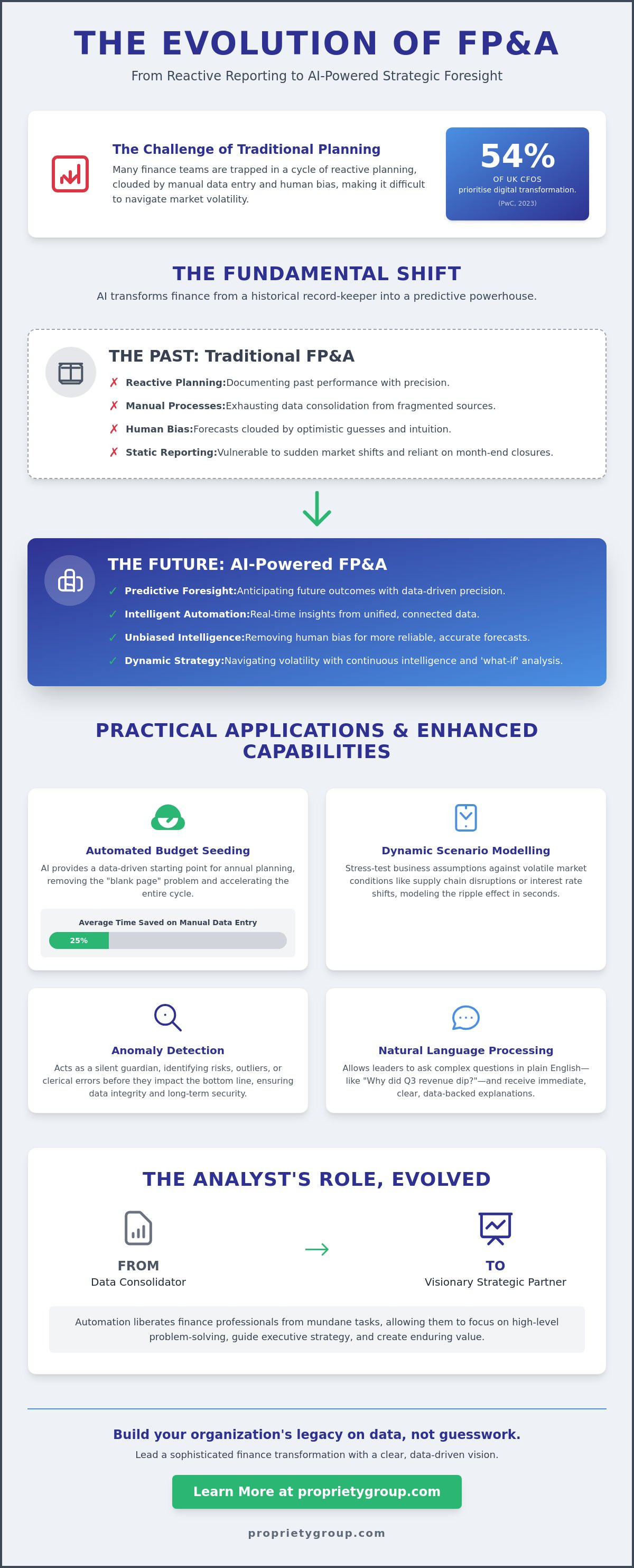
What if the most significant barrier to your company's growth isn't a lack of capital, but the time your team spends looking backwards? A 2023 study by PwC found that 54% of UK CFOs are now prioritising digital transformation to navigate market volatility, yet many still find themselves trapped in a cycle of reactive planning. You're likely familiar with the exhaustion of manual data entry and the unease that comes from forecasts clouded by human bias. Understanding the role of ai in financial planning and analysis is no longer a luxury; it's a fundamental shift in how we define corporate excellence. This transition promises to elevate your finance department from a mere reporting hub into a visionary strategic partner that anticipates change with meticulous precision.
We'll explore how these intelligent systems eliminate fragmented reporting and provide the clarity needed for swift, accurate decision-making. You'll gain the insight required to lead a sophisticated finance transformation, ensuring your organisation's legacy is built on data rather than guesswork. This guide outlines the journey from manual oversight to high-level strategic mastery.
Key Takeaways
- Understand how the role of ai in financial planning and analysis transforms the finance function from a reactive reporting department into a visionary strategic partner that anticipates future trends.
- Learn how predictive intelligence removes human bias from your financial outlooks, allowing for more precise and reliable rolling forecasts.
- Discover the benefits of budget seeding, a method that uses data-driven insights to create a solid foundation for your annual planning cycle.
- Recognise why successful AI adoption requires a clear leadership vision and a unified data source to ensure your strategic decisions are built on integrity and accuracy.
- Explore the shift from traditional record-keeping to a proactive approach that prioritises long-term security and meticulous financial oversight.
Defining the Strategic Evolution of AI in FP&A
The role of ai in financial planning and analysis represents a fundamental shift in how leadership teams interpret data. Historically, finance functions acted as meticulous historians, documenting past performance with precision. Modern AI systems change this dynamic by identifying complex patterns and predicting future outcomes rather than merely recording what has already occurred. This transition allows for a level of foresight that was previously unattainable through traditional methods.
Sophisticated algorithms now process internal figures alongside external market indicators. This ensures that Applications of artificial intelligence in finance provide a holistic view of an organisation's health. It's a move from manual, reactive reporting to a proactive strategy that empowers decision-makers with real-time insights. Instead of waiting for month-end closures, leaders access a continuous stream of intelligence that informs every strategic move.
To better understand this concept, watch this helpful video:
From Historical Reporting to Predictive Foresight
Traditional planning often left UK businesses vulnerable to sudden market shifts, such as the sharp interest rate rises seen throughout 2023. AI-driven foresight enables organisations to navigate such volatility with quiet confidence. By integrating epm advisory into their framework, firms can achieve 'connected planning'. This approach bridges the gap between disparate departments, ensuring that every financial decision aligns with the company's long-term legacy and current market realities.
The Human Element: Analysts as Strategic Advisors
Automation handles the mundane, repetitive tasks of data consolidation. This shift liberates finance professionals from the burden of manual spreadsheets, allowing them to engage in high-level problem-solving. The FP&A professional's role evolves into that of a visionary business partner. They don't just report numbers; they guide executive strategy with bespoke insights. This evolution ensures that human intelligence is focused where it matters most: on creating enduring value and fostering principled growth.
Practical Applications: How AI Enhances Planning and Analysis
The role of ai in financial planning and analysis has shifted from a futuristic concept to a fundamental requirement for modern UK enterprises. By leveraging advanced algorithms, finance teams now move beyond static spreadsheets to embrace predictive forecasting. This transition eliminates the human bias that often clouds traditional rolling forecasts, ensuring that projections are based on historical patterns rather than optimistic guesses. Budget seeding allows AI to provide a data-driven starting point for annual planning cycles, effectively removing the "blank page" problem and saving finance teams an average of 25% of their manual data entry time.
Decision-makers can now engage with their financial data through natural language processing. This technology allows a leader to ask, "Why did our London commercial portfolio revenue dip in Q3?" and receive an immediate, clear explanation. These practical applications of AI in FP&A ensure that strategy is both swift and informed. Anomaly detection acts as a silent guardian, identifying risks or clerical errors before they impact the bottom line, which is vital for maintaining the integrity of a company's legacy.
Dynamic Scenario Modelling and Stress Testing
AI allows for sophisticated 'what-if' analysis at a scale that traditional tools can't match. By using predictive intelligence, firms can stress-test business assumptions against volatile market conditions. If a supply chain disruption caused costs to rise by 15%, or if interest rates shifted by 50 basis points, AI models the ripple effect across the entire business in seconds. This level of preparation ensures long-term security in an unpredictable economy.
Precision in Cash Flow and Variance Analysis
Enhancing the role of ai in financial planning and analysis allows for a meticulous view of future liquidity. Traditional reporting often identifies that a department is £50,000 over budget but fails to explain why. AI identifies the underlying drivers of variance, whether it's an unexpected shift in utility costs or a change in consumer behaviour. This precision ensures that capital is always deployed where it creates the most value. For those seeking to build a resilient financial future, understanding these nuances is essential to strategic growth.
Implementing a Visionary AI Strategy within Your Finance Team
True digital transformation doesn't arrive in a box. It begins with a clear leadership vision rather than a simple software purchase. For UK finance leaders, the role of ai in financial planning and analysis is to act as a catalyst for precision. Success requires a shift from reactive reporting to proactive strategy. This journey starts by selecting a bespoke epm platform that aligns with your specific long term goals. Propriety Group serves as the essential bridge here, connecting technical execution with high level strategic advisory to ensure your investment creates lasting value.
Establishing Robust Data Governance and Integrity
AI models are only as effective as the information they consume. Establishing a "Single Source of Truth" is non-negotiable for maintaining trust in your forecasts. A centralised data warehouse provides the necessary foundation for this unified intelligence. We begin with a meticulous environment analysis to evaluate your current finance landscape. This process identifies gaps in data quality and ensures your systems are ready for advanced analytics. By cleaning and structuring your data now, you prevent the costly errors that arise from fragmented spreadsheets and legacy silos.
Cultivating a Culture of Continuous Innovation
Technology is only half of the equation. Your team must possess the confidence to work alongside these tools effectively. Upskilling is a priority, turning traditional accountants into strategic analysts who can interpret AI generated insights. We don't believe in "set and forget" implementations. Our PG Care model provides ongoing support, ensuring your system evolves as the UK market shifts. This approach fosters a culture where innovation is permanent. It's about creating a legacy of excellence where the role of ai in financial planning and analysis becomes a natural extension of your team's expertise. We focus on the intersection of people and purpose to deliver a finance function that is both resilient and visionary.
Charting the Future of Intelligent Finance
The transition toward automated intelligence isn't just a technical upgrade; it's a fundamental shift in how UK businesses protect their legacy. By moving from manual data entry to predictive modelling, the role of ai in financial planning and analysis empowers teams to anticipate market shifts before they happen. Research from Gartner indicates that 70% of finance leaders will use AI to automate manual processes by 2026, highlighting the urgent need for a structured approach. Success requires more than just new software; it demands a design-led strategy that aligns your people with your long-term purpose.
Propriety Group brings a meticulous eye and a sense of propriety to this evolution. Our expertise in EPM and CRM implementation ensures your systems work in perfect harmony. We don't just deliver a project and leave. Through our PG Care model, we provide the ongoing support necessary to maintain precision and integrity in your reporting. It's about creating a foundation that's both resilient and visionary. We believe that when technology meets principled design, the result is enduring value for your entire organisation.
Explore our bespoke Financial AI Solutions to begin your journey toward a more certain financial future. Your team's potential is waiting to be unlocked.
Frequently Asked Questions
How does AI actually improve the accuracy of financial forecasts?
AI improves accuracy by identifying complex patterns within vast datasets that human analysts often overlook. According to a 2023 study by Gartner, machine learning models can reduce forecast errors by up to 20% in high-volume environments. The role of ai in financial planning and analysis allows firms to incorporate external variables, such as the UK Consumer Price Index which stood at 4.0% in January 2024, into their projections with precision.
These systems don't just rely on historical figures; they adapt to shifting market conditions in real time. This ensures that your financial roadmap remains grounded in current reality rather than outdated assumptions. By removing human bias, the technology provides a more objective view of a company's future performance.
Will AI eventually replace the need for an FP&A team?
AI won't replace the FP&A team, but it'll redefine the professional's daily responsibilities. Research from McKinsey indicates that while 40% of finance activities can be automated, the demand for human judgment and strategic oversight remains essential. Professionals will transition from data gatherers to strategic advisors who interpret machine-generated insights to guide the business forward.
The human element provides the necessary context and ethical considerations that algorithms lack. Leadership requires a nuanced understanding of company culture and long-term legacy, which remains a uniquely human capability. Your team's value will shift toward high-level decision-making and fostering relationships across the organisation.
What are the first steps a CFO should take to integrate AI into finance?
A CFO should begin by conducting a thorough audit of existing data quality and infrastructure. Successful integration depends on a clean, centralised data source, as 80% of an AI project's success often hinges on the integrity of the underlying information. It's wise to start with a small, high-impact pilot project, such as cash flow forecasting, before scaling across the department.
Investing in training is equally vital to ensure the team can work alongside these new tools. By focusing on a specific business problem first, you demonstrate immediate value and build confidence in the technology. This measured approach ensures that the transition is both sustainable and aligned with the firm's broader strategic goals.
What is the difference between traditional automation and AI in financial planning?
Traditional automation follows rigid, pre-defined rules to perform repetitive tasks, whereas AI learns and evolves from the data it processes. The role of ai in financial planning and analysis involves predictive capabilities that go beyond simple "if-this-then-that" logic. While a standard spreadsheet might automate a calculation, an AI system can predict a future shortfall by analysing thousands of disparate variables.
This distinction is crucial for modern finance leaders who require more than just speed. AI provides a level of foresight and adaptability that traditional software cannot match. It transforms the finance function from a reactive reporting department into a proactive engine of growth and stability.