
Choosing Business Intelligence Consultants: A Strategic Guide for Finance Leaders

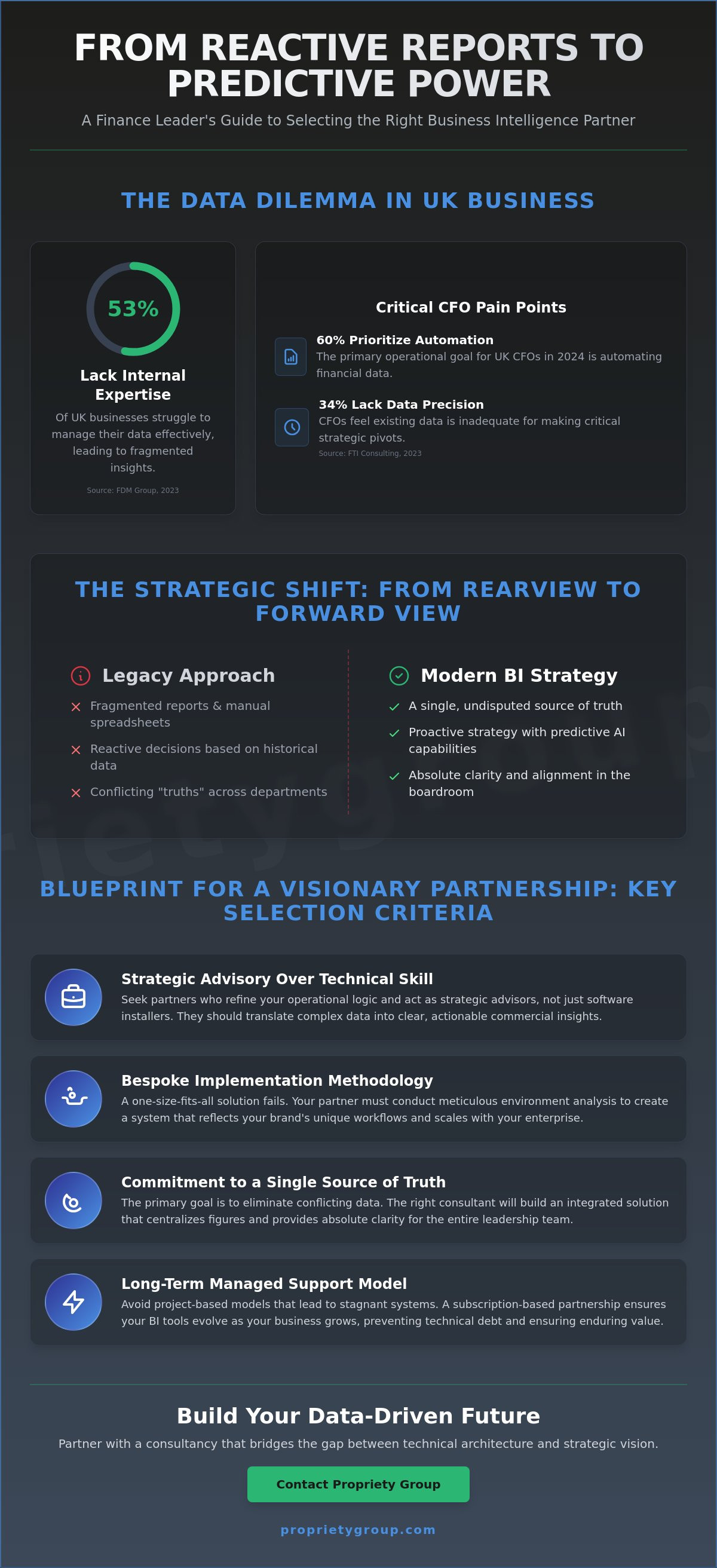
A 2023 study by FDM Group found that 53% of UK businesses lack the internal expertise to manage their data effectively, leaving many finance leaders to rely on fragmented reports that fail to reflect reality. You probably feel the persistent friction of managing disparate systems where the numbers rarely align across departments. It's a common struggle to move beyond reactive planning when your current tools offer little more than a rearview mirror. Partnering with the right business intelligence consultants isn't merely a technical upgrade; it's a commitment to meticulous clarity and strategic integrity that transforms your data into a visionary asset.
In this guide, you'll learn how to identify a bespoke partner who can replace technical jargon with a single source of truth for your entire leadership team. We'll outline a framework for moving from historical reporting to predictive AI capabilities that provide a genuine competitive advantage. This article details the selection process for a long-term support model that evolves alongside your business to ensure your data strategy remains as enduring as your legacy.
Key Takeaways
- Discover how to transition from reactive data collection to a proactive, forward-looking strategy that empowers informed decision-making across your organisation.
- Identify the essential criteria for selecting business intelligence consultants who understand the meticulous requirements of finance leaders and the broader corporate vision.
- Learn how to establish a single source of truth to eliminate conflicting reports and ensure absolute clarity within the boardroom.
- Understand the value of a holistic implementation methodology that supports your team from the initial data migration through to comprehensive user training.
- Explore how integrating advanced intelligence with your financial close process can deliver faster, more precise month-end reporting and long-term security.
The Strategic Role of Business Intelligence Consultants in Modern Organisations
Business intelligence consultants act as the bridge between raw data and commercial clarity. They serve as expert advisors who help organisations replace reactive reporting with proactive, data-driven decision-making. By implementing Business intelligence (BI) strategies, these specialists transform how a board views its own performance. It's no longer enough to look at what happened last month. Finance leaders now require a forward-looking perspective that anticipates market shifts before they occur.
Modern finance teams are rapidly moving away from fragmented, manual spreadsheets. In 2024, approximately 60% of UK CFOs reported that automating financial data is their primary operational goal. These legacy methods often lead to errors and inconsistent versions of the truth. Instead, leaders are investing in integrated business intelligence solutions to centralise their figures. This transition allows for a cohesive planning environment where BI overlaps with EPM advisory, ensuring every financial forecast remains rooted in real-time operational data.
To better understand the practical impact of these experts, watch this helpful video:
Bridging the Gap Between IT and Finance
Experienced business intelligence consultants translate complex data structures into meaningful dashboards for leadership groups. They ensure that technology serves the business purpose, rather than dictating it. This alignment is vital. Without it, expensive software often becomes a burden rather than an asset. A consultant’s role is to ensure tools provide answers, not just more questions, making the technology accessible to every stakeholder.
The Value of a Bespoke Implementation
Off-the-shelf reporting often fails to address unique organisational nuances. Every business has a distinct legacy and specific goals. Meticulous environment analysis is required before any software is configured. A bespoke approach ensures the final system reflects the integrity of the brand’s existing workflows. This precision prevents the common pitfall of forcing a company to fit a rigid software template, instead creating a solution that scales with the enterprise.
Key Criteria for Selecting a Business Intelligence Consultancy
Finance leaders often struggle with fragmented data. In 2023, research from FTI Consulting indicated that 34% of UK CFOs felt their existing data lacked the precision required for strategic pivots. This makes the choice of business intelligence consultants a critical decision. You need a partner who bridges the gap between technical architecture and financial strategy. Success depends on finding a team that prioritises the integrity of your financial narrative over mere software installation.
Technical Proficiency vs. Strategic Advisory
Technical skill is the baseline for any implementation. However, a truly effective consultant acts as a strategic advisor. They don't just build dashboards; they refine your operational logic. By integrating ai in finance, these partners help you move from reactive reporting to predictive intelligence. This shift is essential for Data-Driven Decision Making, turning raw numbers into clear paths for long-term growth.
The Importance of Managed Support Models
Traditional project-based models often leave firms with stagnant systems once the initial contract ends. The PG Care approach replaces these one-off fees with a subscription-based partnership. This ensures your systems evolve as your business scales, preventing the build-up of technical debt. When evaluating business intelligence consultants, look for these specific indicators of quality:
- Deep financial expertise: Partners must speak the language of the CFO and understand UK statutory reporting requirements.
- Holistic methodology: The process should cover everything from initial data migration to bespoke user training.
- Unified views: Proven experience integrating EPM and CRM systems is vital for a single source of truth.
- Ongoing optimisation: Systems require regular refinement to remain useful as market conditions shift.
Meticulous attention to detail during the selection phase prevents user frustration later. It creates a system that serves the people using it. If you're looking to build a resilient financial foundation, exploring a bespoke consultancy partnership can help secure your firm's future legacy.
Transitioning from Data Collection to Forward-Looking Performance
Modern finance leaders recognize that retrospective reporting is no longer enough. The true value of business intelligence consultants lies in their ability to shift a firm's focus from what happened last month to what will happen next year. By establishing a single source of truth, teams eliminate the friction of conflicting reports that often stall boardroom decisions. This clarity ensures every stakeholder operates from the same precise figures, fostering a culture of accountability and trust throughout the organization.
Efficiency gains are most visible when you integrate BI tools directly with the financial close process. This alignment can reduce month-end reporting cycles by up to 40 percent, allowing finance teams to deliver accurate insights while the data is still fresh. With this foundation, leadership can conduct stress testing and scenario modelling with absolute confidence. In a UK market defined by fluctuating interest rates and shifting regulations, the ability to model "what-if" scenarios provides a vital safeguard for long-term capital and strategic growth.
Creating a Legacy of Data Integrity
A firm's history is its most valuable asset. Specialist business intelligence consultants use data warehouses to create permanent, reliable records that withstand the test of time. This process begins with meticulous data migration. It's a bespoke task that ensures legacy information is cleaned and structured correctly. Without this attention to detail, even the most advanced analytics will fail to inspire the confidence required for high-stakes investment decisions.
Future-Proofing Through AI and Analytics
AI doesn't have to be complex. In a strategic BI context, it simply automates routine forecasting tasks that previously consumed hundreds of manual hours. This shift frees your finance team to focus on high-level strategy and relationship building. AI's role in BI is the transition from 'what happened' to 'what will happen next'. By leveraging these tools, firms gain a predictive edge that allows them to anticipate market volatility before it impacts the bottom line.
Securing Your Organisation’s Financial Legacy
The shift from reactive data collection to proactive, forward-looking performance defines the next era of financial leadership. Success requires more than just new software; it demands a meticulous alignment between your strategic purpose and the tools used to achieve it. Engaging the right business intelligence consultants acts as a catalyst for this transformation, turning fragmented figures into a clear narrative of future growth within the 2024 UK market. Our approach at Propriety Group focuses on this vital intersection of people and precision.
We provide a refined path forward through our PG Care managed support model and deep expertise as specialists in EPM and financial AI. This authoritative, expert-led implementation methodology ensures that every project is handled with integrity and bespoke care. It's not just about installing systems; it's about building enduring value that protects your professional legacy. By focusing on clarity and high-level strategy, we help you move beyond simple reporting toward true financial foresight. Discover how Propriety Group’s advisory services can transform your financial data into a strategic asset. Your journey toward a more insightful and secure financial future starts with a single, principled step.
Frequently Asked Questions
What exactly do business intelligence consultants do for a finance team?
Business intelligence consultants refine raw financial data into clear, actionable visualisations that drive strategic decision-making. They meticulously integrate disparate systems, such as accounting software and sales databases, into a single source of truth. By automating these bespoke workflows, it's common for consultants to reduce the time spent on manual reporting by 40%. This allows finance leaders to focus on high-level analysis and the long-term legacy of the firm.
How long does a typical BI implementation project take to complete?
A comprehensive BI implementation usually requires between 14 and 36 weeks to reach full operational maturity. Initial phases focusing on core financial reporting can often be delivered within the first 90 days. Larger projects involving complex data cleansing or multiple international entities take longer to ensure total precision. Industry data from 2023 indicates that 55% of UK businesses complete their primary rollout within 6 months of commencement.
What is the difference between a BI tool and an EPM platform?
A BI tool excels at visualising what has already occurred, whereas an EPM platform is purpose-built for future-focused planning and budgeting. BI provides the dashboard that tracks daily performance against key targets. EPM systems manage the intricate processes of financial forecasting and consolidation. Industry reports show that firms using both tools in tandem see a 15% improvement in forecast accuracy compared to those using spreadsheets alone.
Can business intelligence consultants help with cloud data migration?
Business intelligence consultants are essential partners for migrating sensitive financial data from legacy on-premise servers to secure cloud platforms. They oversee the entire transition to ensure that no historical records are lost or compromised during the move. This shift typically lowers infrastructure costs by 20% while improving data accessibility for remote teams. They ensure every step aligns with UK GDPR requirements to protect your corporate reputation and data integrity.