
Predictive Forecasting Models in Finance: A Strategic Guide to Forward-Looking Intelligence

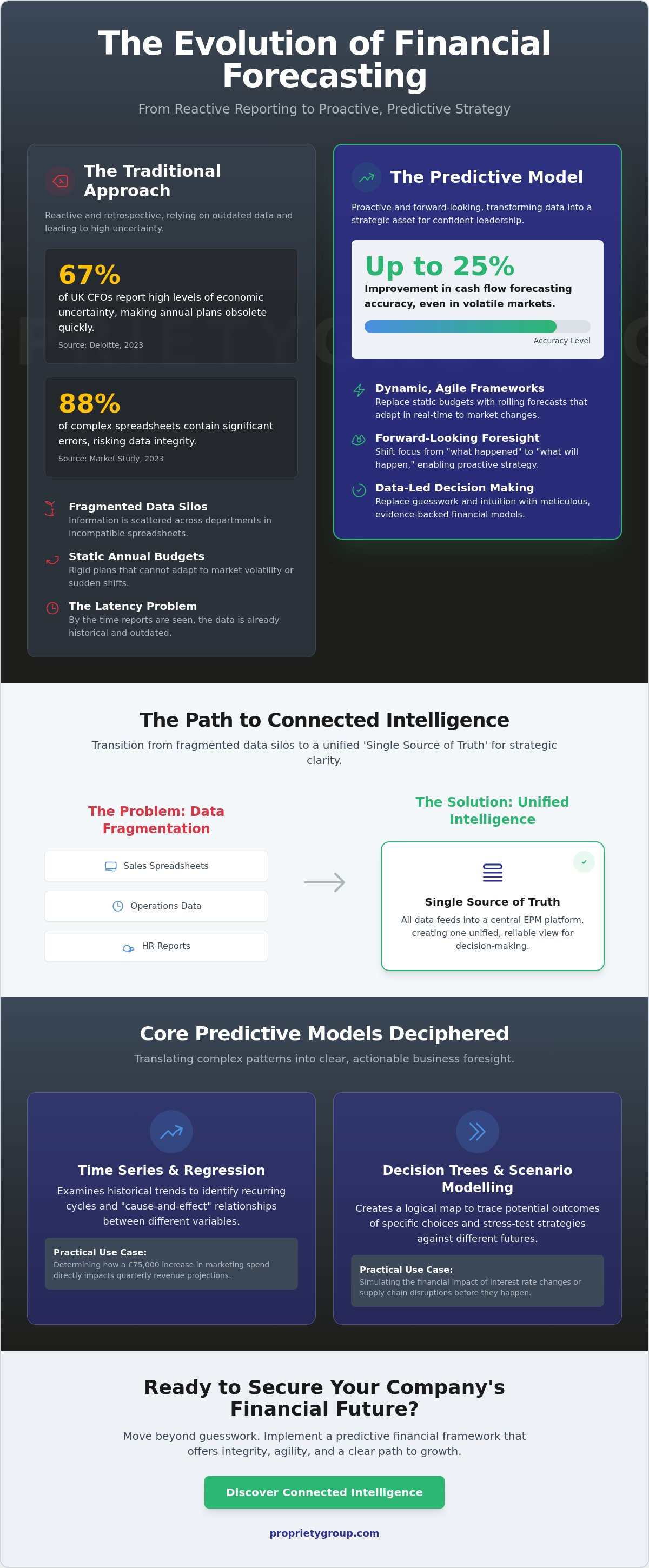
A budget drafted in January is often little more than a historical artifact by the end of the first quarter. According to a 2023 Deloitte survey, 67% of UK chief financial officers reported high levels of economic uncertainty, which makes traditional annual plans nearly impossible to maintain. Many finance directors find their strategic vision clouded by fragmented data that lives in different departments. Adopting predictive forecasting models in finance allows you to bridge this gap, replacing guesswork with a meticulous, data-led approach to growth.
It's natural to feel a sense of uneess when your long-term forecasts lack the precision required for high-stakes decisions. You require a financial framework that offers both integrity and bespoke agility to protect your company's legacy. We'll show you how these advanced models transform raw numbers into clear, actionable foresight for more confident leadership. This guide provides a clear roadmap for moving toward rolling forecasts; it's designed to ensure your cash flow predictions remain accurate and your financial goals stay firmly aligned with your broader purpose.
Key Takeaways
- Transition from reactive accounting to proactive strategy by understanding the shift from historical data to forward-looking intelligence.
- Discover how implementing predictive forecasting models in finance allows leaders to replace static, rigid budgets with dynamic, agile frameworks.
- Learn the essential steps to cultivate a 'Single Source of Truth,' ensuring your strategic decisions are anchored in meticulous data integrity and unified intelligence.
- Identify the core categories of predictive models and their bespoke applications, translating complex patterns into clear, actionable business foresight.
- Master the path to connected intelligence by moving beyond isolated spreadsheets to a sophisticated environment that secures long-term financial stability.
Moving Beyond Reactive Planning: The Evolution of Predictive Forecasting
Modern finance has moved past the era of mere retrospection. Traditionally, leaders looked at the previous year's performance to guess the next. Today, predictive forecasting models in finance represent a fundamental change. They move us from asking what happened to determining what will happen next. By 2026, the speed of the UK market will require decisions made in hours, not weeks. Static budgets that sit in a drawer for 12 months are no longer viable. They lack the agility needed to respond to sudden shifts in the economic environment.
Reliability depends on meticulous data integrity. If the foundation is flawed, the projection fails. High-quality Predictive modelling ensures that every pound (£) of investment is backed by evidence rather than intuition. This approach creates a legacy of precision, allowing a business to remain resilient during periods of volatility. It's about replacing guesswork with a calculated, visionary outlook.
To better understand how these techniques are applied practically, watch this helpful video:
From Historical Reporting to Forward-Looking Insights
Historical data is the bedrock of any bespoke financial model. However, isolated data is a risk. We now embrace connected planning. This means the sales team, operations, and HR all feed into a single financial truth. The introduction of ai in finance acts as the primary catalyst here. It processes vast datasets to find patterns that were previously invisible. It's about creating a visionary path for growth by using the past to illuminate the future.
Why Traditional Spreadsheets Fail the Modern CFO
Spreadsheets often lead to fragmented silos. A 2023 study found that 88% of complex spreadsheets contain significant errors. This creates the latency problem. By the time a CFO sees a report, the information is already outdated. Predictive models identify non-linear trends. They spot sudden shifts in UK consumer behaviour or interest rate changes before they become crises. This level of foresight is essential for maintaining corporate propriety and long-term security. It ensures that leadership is always one step ahead.
Core Predictive Models Deciphered: A Guide for Finance Leaders
Precision in financial planning requires more than just historical data; it demands a meticulous selection of predictive forecasting models in finance that align with your specific industry needs. Selecting a bespoke model ensures that the intelligence generated is both relevant and actionable. These frameworks operate most effectively when integrated within a robust epm platform, where they automate routine data processing and allow leaders to focus on high-level strategy. The implementation of predictive forecasting models in finance provides a clear advantage, turning raw data into a narrative of future growth.
Time Series and Regression: Finding Patterns in the Noise
Time series analysis examines historical trends to identify recurring cycles, such as seasonal fluctuations in the UK retail sector. Regression goes a step further by identifying the "cause and effect" relationship between different factors. For instance, a finance team might use regression to determine exactly how a £75,000 increase in digital marketing spend impacts quarterly revenue. While these methods are foundational, researchers are increasingly exploring deep learning models for financial forecasting to capture even more intricate market signals. By combining these approaches, businesses have seen cash flow forecasting accuracy improve by up to 25% in volatile markets.
Decision Trees and Scenario Modelling: Mapping Future Possibilities
Decision trees act as a logical map, tracing the potential outcomes of specific business choices. This visual approach helps leaders understand the cascading effects of a single investment or divestment. Scenario modelling complements this by allowing teams to stress test their strategies against external shocks, such as sudden shifts in interest rates or supply chain disruptions. This proactive methodology transforms uncertainty into a series of manageable options. It empowers finance directors to move with confidence, knowing their legacy is protected by rigorous, data-led foresight. If you're looking to refine your approach, exploring how to select the right platform can provide the necessary foundation for these advanced tools.
Implementing Predictive Models: The Path to Connected Intelligence
Moving from a conceptual framework to a live environment requires a meticulous approach to architecture. It starts by identifying specific business questions that need answering, followed by the consolidation of disparate data streams. A central pillar of this transition is the establishment of a "Single Source of Truth" through a data warehouse. This unified repository eliminates the friction of conflicting reports, which often costs UK firms up to 15% of their potential annual productivity. Transparency remains the most effective tool to dismantle the fear of "Black Box" algorithms. By documenting model logic and assumptions, leaders can trust the outputs of their predictive forecasting models in finance without feeling sidelined by the technology. Professional advisory serves as the essential bridge here, ensuring that technical capability translates directly into strategic execution.
The Role of Data Quality and System Integration
Clean data acts as the vital foundation for any sophisticated predictive model. Without it, even the most advanced algorithms produce flawed results. Integrating ERP, CRM, and EPM systems allows for a 360-degree view of the business, connecting sales pipelines with operational costs. Data hygiene is the meticulous process of ensuring information is accurate, timely, and relevant for modeling. This rigour ensures that the intelligence generated is both reliable and actionable for long-term planning.
Balancing Machine Precision with Human Expertise
The most resilient forecasts emerge where AI-driven data meets human intuition. While machines excel at processing vast datasets, they lack the nuanced understanding of market shifts or cultural variables that a seasoned professional possesses. Modern finance teams have evolved into strategic interpreters who translate model outputs into meaningful business narratives. Adopting an epm advisory approach ensures that technology remains a servant to purpose, aligning technical precision with the overarching legacy of the organisation.
Securing Your Financial Legacy Through Precision
Transitioning from reactive spreadsheets to sophisticated predictive forecasting models in finance allows leaders to anticipate market shifts before they impact the balance sheet. By integrating historical data with real-time variables, firms can move beyond simple historical analysis. This evolution is essential for maintaining a competitive edge. The Financial Reporting Council's 2023 report emphasises that data integrity is now the cornerstone of trust in UK corporate reporting. Success depends on more than just software; it's about a meticulous approach to information and a commitment to connected intelligence across the entire organisation.
Propriety Group delivers this through bespoke Enterprise Performance Management (EPM) implementations that focus on long-term strategic growth. Our expert-led advisory ensures your data remains accurate and reliable, while the PG Care model provides the continuous support needed for lasting excellence. We're here to help you turn foresight into a permanent advantage. Empower your leadership with our Financial AI Solutions. Your path to a resilient and visionary financial future starts with the right partner.
Frequently Asked Questions
What is the primary difference between traditional and predictive forecasting?
Traditional forecasting relies on historical averages and linear trends to project future performance. In contrast, predictive forecasting models in finance utilise advanced algorithms to identify complex patterns within vast datasets. This shift from reactive analysis to proactive intelligence allows UK firms to anticipate market shifts before they occur. It moves beyond simple spreadsheets to a more meticulous, data-driven strategy.
How accurate are predictive models during periods of high market volatility?
Predictive models maintain a higher degree of precision than manual methods by processing real-time variables during market fluctuations. Industry reports from 2023 showed that during the 2022 inflationary spike in the UK, firms using automated models reported a 15% improvement in forecast accuracy. These systems adapt to new data inputs rapidly. This ensures that your strategic decisions remain grounded in current reality rather than outdated assumptions.
Do we need to hire a team of data scientists to use these models effectively?
You don't need a dedicated team of data scientists to implement these sophisticated tools. Modern software provides intuitive interfaces that allow financial directors to manage predictive forecasting models in finance without deep coding knowledge. Most platforms now offer bespoke dashboards designed for clarity and ease of use. This democratises access to high-level intelligence, making it a viable asset for both boutique firms and established corporations.
How long does it typically take to see a return on investment from predictive forecasting?
Most UK businesses observe a measurable return on investment within 6 to 12 months of implementation. This timeline accounts for the initial data integration phase and the subsequent refinement of the model's accuracy. By the end of the first year, the reduction in operational waste and improved capital allocation often covers the initial software costs. It's a calculated investment that builds a legacy of financial integrity and foresight.