

The moment your new software goes live isn't the finish line; it's the starting block for your organization's true financial evolution. You likely invested in an Enterprise Performance Management system to escape the limitations of manual spreadsheets and fragmented data. However, many finance leaders find that the initial launch doesn't immediately solve the issue of low user adoption or disconnected reporting. It's a common frustration to see a significant investment feel more like a digital filing cabinet than a visionary tool. Conducted with precision, a post-implementation epm system review ensures your technology aligns with your human experience and strategic intent.
We understand that you need more than just a functioning platform; you require a system that acts as a pillar of long-term security and predictive planning. With the EPM market projected to reach $11.89 billion by 2031, the standard for excellence is higher than ever. This article promises to show you how a structured review provides the evidence of ROI your stakeholders demand while refining your transition from reactive reporting to proactive foresight. We'll examine the steps to optimize your setup, ensuring your financial transformation is both permanent and profoundly effective.
Key Takeaways
- Understand why a formal evaluation should follow at least one full reporting cycle to ensure your performance data reflects authentic business usage.
- Identify the specific criteria for success that bridge the gap between basic technical stability and high-level strategic foresight.
- Learn how a post-implementation epm system review creates a clear, prioritized roadmap for optimizing your software and processes.
- Discover how professional support services ensure your system remains a reliable pillar of long-term security and operational precision.
The Strategic Value of a Post-Implementation EPM System Review
A post-implementation epm system review is a formal evaluation of your platform, your internal processes, and your people. It occurs after the initial deployment phase, serving as a vital audit of how the technology integrates with daily operations. While many organizations view the "go-live" date as the conclusion, true mastery of the enterprise requires a deeper look at how the system functions under real-world pressure. This assessment isn't a mere checklist; it's a principled examination of whether the digital craftsmanship of the system translates into enduring value through effective Business performance management.
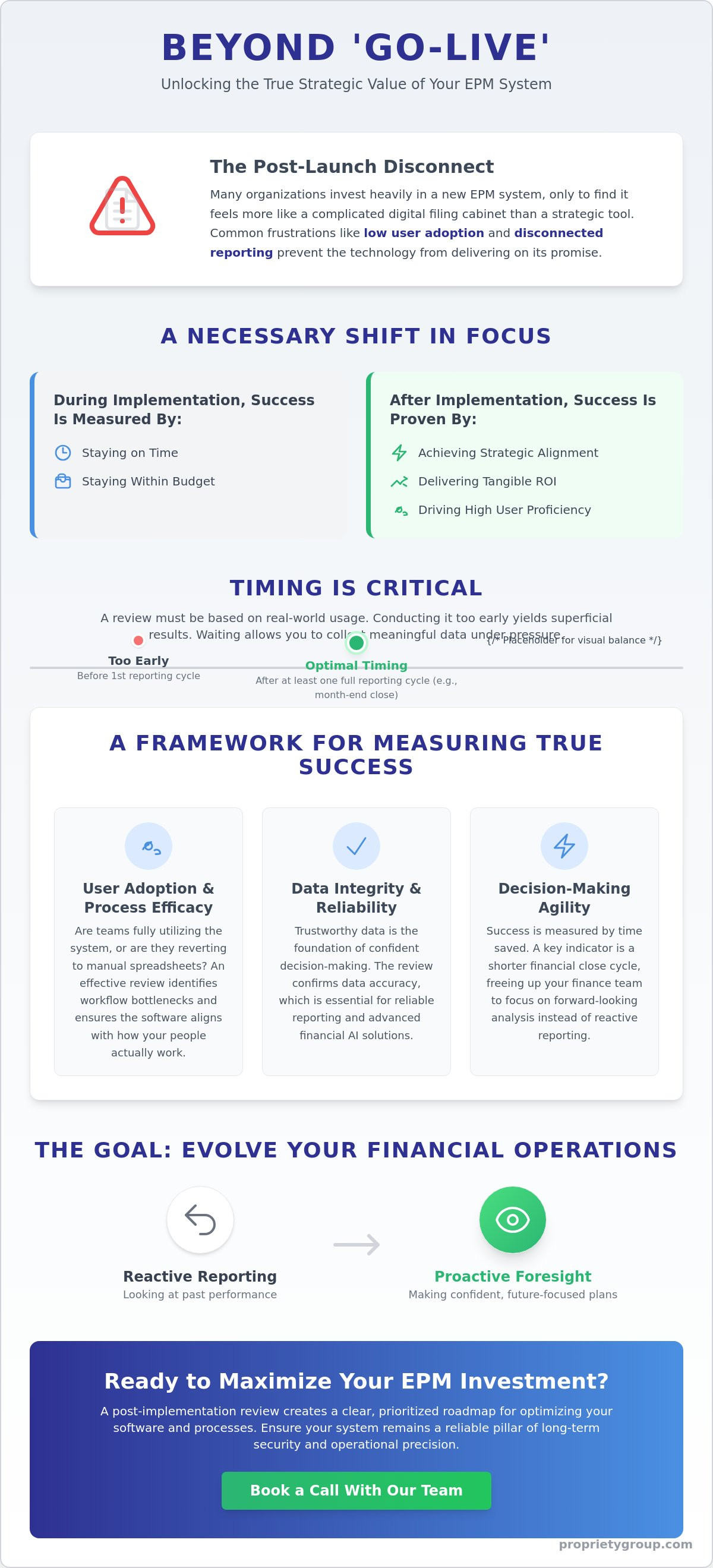
Timing is a critical element of this process. Conducting a post-implementation epm system review too early often yields superficial results. We recommend waiting for at least one full reporting cycle to conclude. This duration allows your finance staff to encounter the nuances of month-end or quarter-end closing, providing a wealth of meaningful usage data. By observing how the system handles these high-stakes periods, you gain clear evidence of its reliability and precision.
To better understand the practical application of these concepts, observe this webinar on implementation success:
The focus of this review represents a shift in perspective. During implementation, success is often measured by whether the project remained on time and within budget. While these are important metrics, they don't guarantee business success. A rigorous review looks beyond the installation to confirm realized benefits and strategic alignment. It provides the board with transparent evidence of performance, building a foundation of trust that the investment supports forward-looking decisions rather than just reactive reporting.
Moving Beyond the Go-Live Milestone
In the context of professional ongoing support services, "live" is simply the beginning of the journey. A common mistake is treating the system as a finished product once the software is operational. This mindset often leads to a reactive approach where teams only address snags as they arise. By choosing proactive optimization instead, you ensure the system evolves alongside your business goals. This transition from basic functionality to high-level strategic intelligence is what distinguishes a standard implementation from a true financial transformation.
A Framework for Measuring EPM Success and ROI
Measuring the success of a digital transformation requires a shift from technical checklists to strategic outcomes. A post-implementation epm system review provides the necessary framework to evaluate if the platform delivers on its promise of precision. Success criteria must span from basic technical stability to the quality of insights that drive the business forward. Without this structured assessment, it's difficult to determine if the digital infrastructure truly supports the organization's vision or if it's merely a modern version of an old problem.
The human element remains a significant variable in this equation. Software is only as effective as the people operating it, making user proficiency a top priority. ROI in an EPM context is the reduction in manual reporting hours combined with increased forecast accuracy. Achieving this return depends heavily on data integrity, which serves as the indispensable foundation for advanced financial AI solutions. When data is reliable, leadership gains the quiet confidence needed to act with certainty.
Assessing User Adoption and Process Efficacy
Identify common bottlenecks where users might be reverting to manual spreadsheets outside the system. These workarounds often signal that the software is too complex or doesn't align with the actual workflow of the finance staff. It's also vital to evaluate if the original business requirements still hold true. As organizations evolve, they often outgrow their initial configurations, necessitating a refined approach to maintain standards of correctness.
Evaluating Decision-Making Agility
Efficiency is best measured by the time saved during the financial close. Reducing the duration of this cycle allows the finance team to move from reactive reporting to predictive planning. Determine if leadership now has access to the forward-looking data required for confident stress testing and strategic agility. If the system fails to provide these insights, it's a clear indicator that further optimization is required to protect the long-term security of the investment.
Optimising Your EPM Environment for Long-Term Value
A completed post-implementation epm system review is more than a final report; it's a strategic blueprint for your future. The insights gathered from the evaluation should lead directly into a prioritised roadmap for system enhancements. This ensures that the platform doesn't remain static while your business evolves. By identifying gaps in functionality or areas where user adoption is lagging, you can direct resources toward improvements that offer the highest impact on your financial operations. It's about moving from a state of basic stability to one of constant refinement.
Maintaining the health of your environment requires a commitment to ongoing support services. These services bridge the gap between the initial setup and the daily reality of a high-performing finance team. They ensure user proficiency remains high and that the system continues to operate with the precision expected of an enterprise-grade solution. A well-maintained system serves as the perfect launchpad for AI in finance, providing the clean, structured data necessary for predictive intelligence. This continuous improvement cycle transforms your software from a simple tool into a visionary asset.
Scaling with Managed Support and Strategic Advisory
Adopting a subscription-based support model, such as PG CARE - EPM Solution Support, allows you to address issues identified during your post-implementation epm system review with agility. This structured approach provides a sense of long-term security, knowing that experts are available to refine the system as your needs change. It's a proactive way to manage your investment. Regular advisory prevents system drift, a common scenario where software slowly loses its alignment with the broader business strategy. By staying connected to a visionary partner, you ensure your technology continues to create enduring value and supports your principled approach to financial management. This partnership fosters a culture of excellence where every update serves a clear, intentional purpose.
To ensure your financial transformation continues to deliver measurable results and strategic foresight, it's essential to have expert guidance at every stage. We invite you to book a call with our team today to discuss how we can support your long-term success.
Securing Your Strategic Evolution
The journey toward true financial transformation doesn't end once the software is installed. It matures through a deliberate post-implementation epm system review. By shifting your focus from the initial launch to long-term optimization, you ensure your technology remains a pillar of reliability and prestige. You've seen how a structured framework reveals the true ROI of your investment, turning manual reporting into predictive foresight. This process creates the necessary alignment between your human experience and your digital tools, ensuring every action is intentional.
Since 2019, our team has specialized in the seamless integration of EPM and CRM systems, bringing a visionary approach to AI and predictive analytics. Our comprehensive PG Care support model provides the quiet confidence you need to maintain excellence long after implementation. We prioritize thoroughness and transparency to turn your financial data into a permanent strategic asset. Ensure your system is performing at its peak; book a call with our expert team to schedule your review. We look forward to helping you build a future of enduring value and long-term security.
Frequently Asked Questions
When is the best time to conduct a post-implementation EPM review?
The ideal time to conduct a post-implementation epm system review is typically three to six months after the initial launch, ensuring at least one full reporting cycle has concluded. This duration allows the finance team to navigate the complexities of month-end or quarter-end closing under the new system. Waiting for this milestone provides authentic data on how the software performs during high-pressure periods rather than just evaluating its basic functionality.
Who should be involved in the EPM system review process?
A successful review requires a collaborative effort between the CFO, the finance staff who use the system daily, and technical advisors. Finance leaders provide the strategic vision, while end-users offer essential feedback on practical workflows and potential bottlenecks. Including external specialists ensures a principled, objective assessment that aligns the technical setup with the human experience and broader business objectives, creating a sense of long-term security.
What are the most common issues discovered during a post-implementation review?
Common discoveries during a post-implementation epm system review include low user adoption and the persistence of manual spreadsheets outside the platform. These issues often stem from insufficient training or a misalignment between the system's configuration and the actual business processes. Reviews also frequently identify data silos where information remains disconnected, preventing the organization from achieving the desired "single version of truth" for strategic decision-making and predictive planning.
How does a PIR help in transitioning to AI-driven financial planning?
A post-implementation review serves as the critical foundation for transitioning to AI-driven planning by ensuring data integrity and structural correctness. Predictive intelligence requires clean, organized datasets to generate accurate forecasts. By refining the environment during a review, you create a stable launchpad where advanced financial AI solutions can operate with precision, moving your organization from reactive reporting to visionary, forward-looking insights that support confident growth.