

While 75% of organizations now utilize AI within their finance departments, a staggering number of executives still rely on manual data entry and fragmented spreadsheets to guide their most critical decisions. You likely understand the friction caused by data silos and the lack of confidence that stems from outdated forecasting methods. This misalignment between technology and intentionality often prevents a firm from reaching its full potential. By optimising your financial planning software, you can elevate your operations from basic reporting to a sophisticated system of predictive intelligence.
In this guide, we'll show you how to cultivate a single source of truth that unifies your financial and operational data. You'll learn how to run complex scenario models instantly, allowing you to lead with quiet confidence rather than reacting to market shifts. We'll explore the strategic steps necessary to build an enduring foundation for growth in 2026 and beyond, ensuring your decision-making remains precise and your vision remains clear.
Key Takeaways
- Learn why reactive planning leads to missed opportunities and how to transition toward a proactive, strategic leadership model.
- Eliminate manual errors and fragmented data by establishing a single source of truth for all your financial and operational information.
- Discover the power of optimising your financial planning software to harness AI-driven predictive intelligence and complex scenario modeling.
- Follow a phased roadmap to identify operational bottlenecks and configure your software environment for maximum strategic impact.
Beyond Basic Implementation: The Strategic Necessity of Software Optimisation
True excellence in optimising your financial planning software lies in treating these tools as living systems rather than static repositories. It's a continuous, deliberate process of refining how data flows through your organization and how your predictive logic evolves to meet new challenges. Many leaders view software as a one-time setup, yet those who achieve enduring value understand that technology must be meticulously tuned to remain aligned with a firm's visionary goals.
When reporting remains fragmented, the organization often falls into a cycle of reactive planning. This approach forces leadership to make decisions based on what happened weeks ago, rather than what's likely to occur tomorrow. By adhering to the foundational principles of corporate finance, we see that capital must be allocated with absolute precision. This level of accuracy is impossible when data's trapped in disconnected spreadsheets. Delayed decisions represent a significant cost, often manifesting as missed market opportunities or inefficient resource distribution.
To better understand how these systems function in a professional environment, watch this helpful overview:
The transition from traditional ERP silos to a connected environment marks a fundamental shift in philosophy. While an ERP system excels at recording the past, a high-performance planning environment illuminates the future. It moves the focus from historical accounting to forward-looking strategy, providing a holistic view of performance that integrates every department into a single, cohesive narrative. This visionary approach ensures your technology acts as a beacon, guiding your firm through volatile conditions with steady, quiet confidence.
The Shift from Fragmented Reporting to Connected Planning
A common pitfall in many firms is the presence of disconnected data. Finance teams often work in isolation from operations, leading to conflicting reports and a lack of trust in the numbers. Connected planning resolves this by ensuring every part of the business speaks the same language. It creates a seamless link between high-level strategy and daily execution. To successfully navigate this transition, many leaders look to EPM Advisory as a guiding framework, ensuring their technological investments are matched by a clear, expert-led strategy.
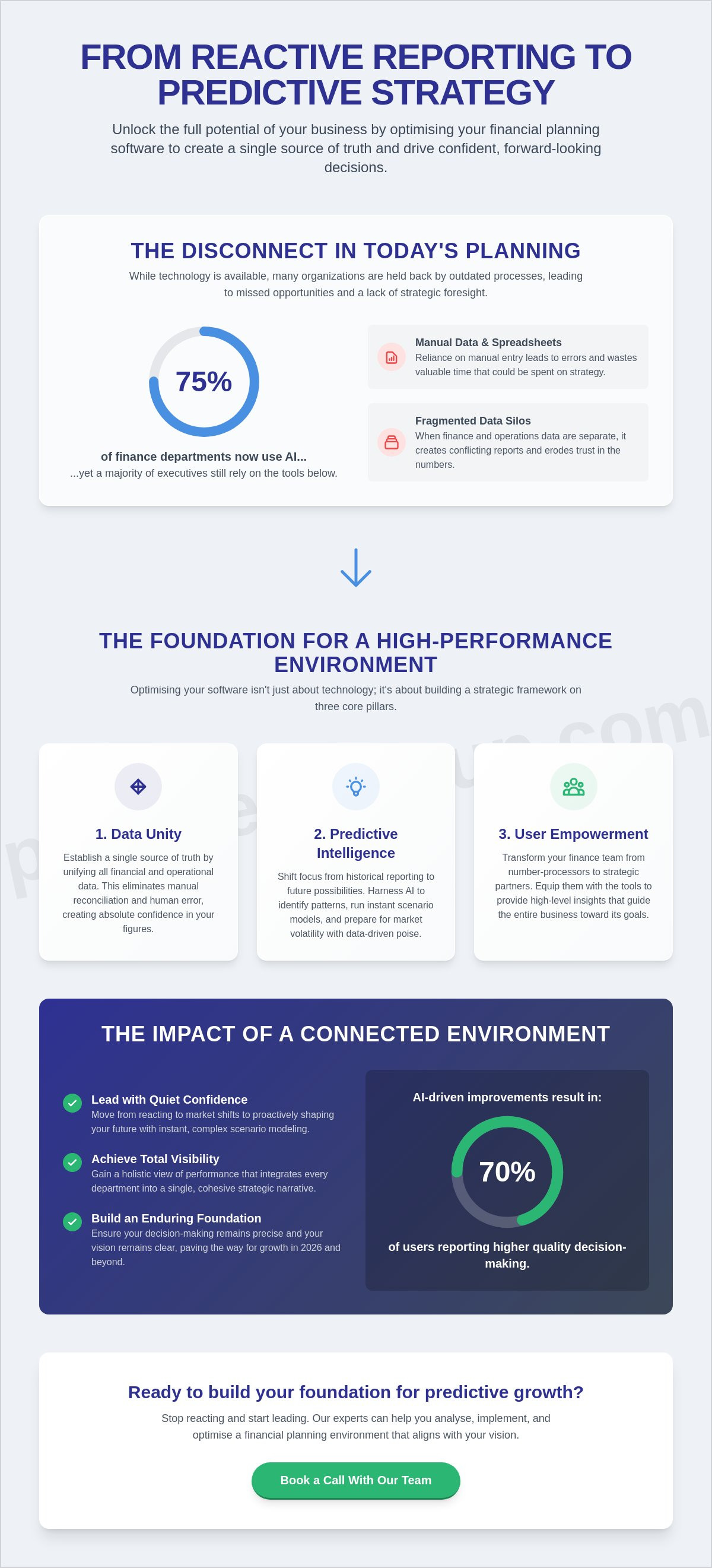
Three Pillars of a High-Performance Financial Planning Environment
Establishing a high-performance environment requires more than just high-end tools. It demands a structural alignment between data, intelligence, and the people who interpret them. When optimising your financial planning software, you must focus on three core pillars that transform a standard reporting tool into a strategic engine for the enterprise.
Data unity is the first essential pillar. By creating a single source of truth, you eliminate the tedious manual reconciliation that often leads to human error. This clarity allows for absolute certainty in your figures. Predictive intelligence follows, shifting the focus from historical data to future possibilities. As we look at the future of financial planning and analysis, it's clear that AI is the catalyst for this change. 'AI in finance is not a replacement for human judgment, but a precision tool that amplifies it.' Finally, user empowerment ensures your finance team isn't just processing numbers but acting as strategic partners who provide high-level insights to the broader business.
Integrating AI and Predictive Analytics for Strategic Growth
AI now identifies subtle patterns in historical data that human analysis might overlook. With 75% of organizations actively using AI in their finance functions as of 2026, the technology has proven its ability to improve decision-making quality for 70% of users. This predictive power is vital for complex tasks like workforce planning and OPEX management. By running instant scenario models, you can prepare for market volatility with poise. You may wish to explore financial AI solutions to see how these tools translate into real-world strategic advantages.
The Importance of a Unified Data Warehouse
A unified data warehouse acts as the backbone for scaling your software performance. It centralizes information from disparate sources, ensuring that your EPM and CRM systems work in harmony. This architectural precision is what allows for rapid, accurate reporting as your organization grows. For a deeper look into the technical framework required for this level of intelligence, you can read the CFO’s guide to data warehouses. If you're ready to refine your current environment, you can speak with our advisory team to discuss a tailored approach.
Executing Your Optimisation Roadmap: Analysis, Implementation, and Care
Success in optimising your financial planning software isn't a destination, but a meticulously planned journey. It begins with a thorough environment analysis, where we identify the specific bottlenecks that currently hinder your reporting cycles. This phase is about uncovering why data silos exist and where manual workarounds are slowing your momentum. By understanding these friction points, we can design a system that works in harmony with your team's unique workflow and strategic intent.
Implementation follows as a targeted exercise. We don't simply install tools; we configure your EPM and CRM software to resolve the fragmented reporting issues identified during analysis. This ensures that every digital touchpoint serves a purpose, contributing to a unified architecture that supports precise decision-making. However, the most common mistake is the 'set and forget' mentality. Without ongoing attention, even the most sophisticated systems begin to decay. This is why we've developed PG CARE, a solution support model designed to preserve the precision and value of your investment over the long term.
Sustaining Excellence with Managed Support Models
Managed support is about more than just fixing technical issues. It's an ongoing advisory relationship that ensures your software evolves alongside your business strategy. Subscription-based support keeps your team's skills sharp and ensures that as new features emerge in the 2026 landscape, you're ready to use them immediately. This proactive approach maintains the high standards of correctness required for strategic leadership, preventing the gradual decline in data quality that often plagues unmanaged systems.
Moving Forward with Confidence
The journey from fragmented spreadsheets to a visionary, AI-enhanced finance function requires both technological expertise and a deep understanding of organizational design. By optimising your financial planning software through a structured roadmap, you create a foundation for enduring value and quiet confidence. Expert consultancy provides the steady hand needed to navigate these complexities, ensuring your transition to a high-performance environment is both seamless and successful. If you're ready to begin this transformation, you can explore our full range of services to see how we align technology with your broader business vision.
Cultivating Enduring Value Through Strategic Alignment
The path to strategic growth in 2026 requires a fundamental shift in how your organization views its technological foundations. By moving beyond basic reporting and optimising your financial planning software, you transition from managing historical facts to shaping future outcomes. We've explored how a unified data environment and predictive intelligence empower your team to act as visionary leaders. Success isn't found in a single implementation, but in the continuous alignment of your tools with your evolving business strategy.
Our team brings specialized expertise in EPM and CRM implementation to ensure your roadmap is both practical and aspirational. Through the PG CARE managed support model, we provide the ongoing vigilance needed to prevent system decay and maintain absolute precision in your forecasts. Our visionary approach to AI and predictive analytics ensures your firm remains at the forefront of the industry. If you're ready to transform your financial environment into a high-performance engine for growth, book a call with our advisory team to discuss your software optimisation needs. The future of your finance function is one of clarity, confidence, and enduring value.
Frequently Asked Questions
What are the first signs that my financial planning software needs optimisation?
The most prominent sign is a persistent reliance on manual data entry and Excel-based workarounds to bridge gaps in your reporting. When your finance team spends more time reconciling data silos than providing strategic insights, the system's efficiency has likely peaked. You might also notice a lack of confidence in your forecasts during volatile market conditions, indicating that your current setup lacks the predictive intelligence required for modern leadership. This friction suggests that optimising your financial planning software is necessary to restore operational harmony.
How does AI specifically improve the accuracy of rolling forecasts?
AI improves accuracy by identifying subtle patterns in historical data that traditional linear models often overlook. Research from June 2026 indicates that 70% of organizations using AI in finance report improved decision-making quality due to these insights. By automating variance analysis and adjusting for seasonal or market shifts in real-time, AI allows your team to move beyond static budgets. This creates a dynamic environment where your software leads to more reliable, forward-looking projections that reflect current market realities.
Can existing EPM software be optimised without a full system replacement?
Most established systems can be significantly enhanced through targeted refinement of data flows and predictive logic without requiring a total replacement. Optimization often involves reconfiguring integrations between your EPM and CRM tools to eliminate fragmented reporting and establish a single source of truth. This approach preserves your existing investment while elevating its performance to meet new strategic demands. It's a process of meticulously tuning the environment to align with your current vision rather than starting from scratch.
What is the typical timeline for a finance software optimisation project?
A typical optimization roadmap generally spans between three to six months, depending on the complexity of your current technological environment. The process begins with a detailed analysis phase to identify specific bottlenecks, which usually takes several weeks of focused investigation. Following this, the implementation of targeted configurations and AI integration occurs in a measured, steady flow. While individual timelines vary, the focus always remains on creating enduring value and ensuring your team is fully empowered to lead with the updated system.