
Automating Variance Analysis Reporting: A Strategic Guide for Finance Leaders

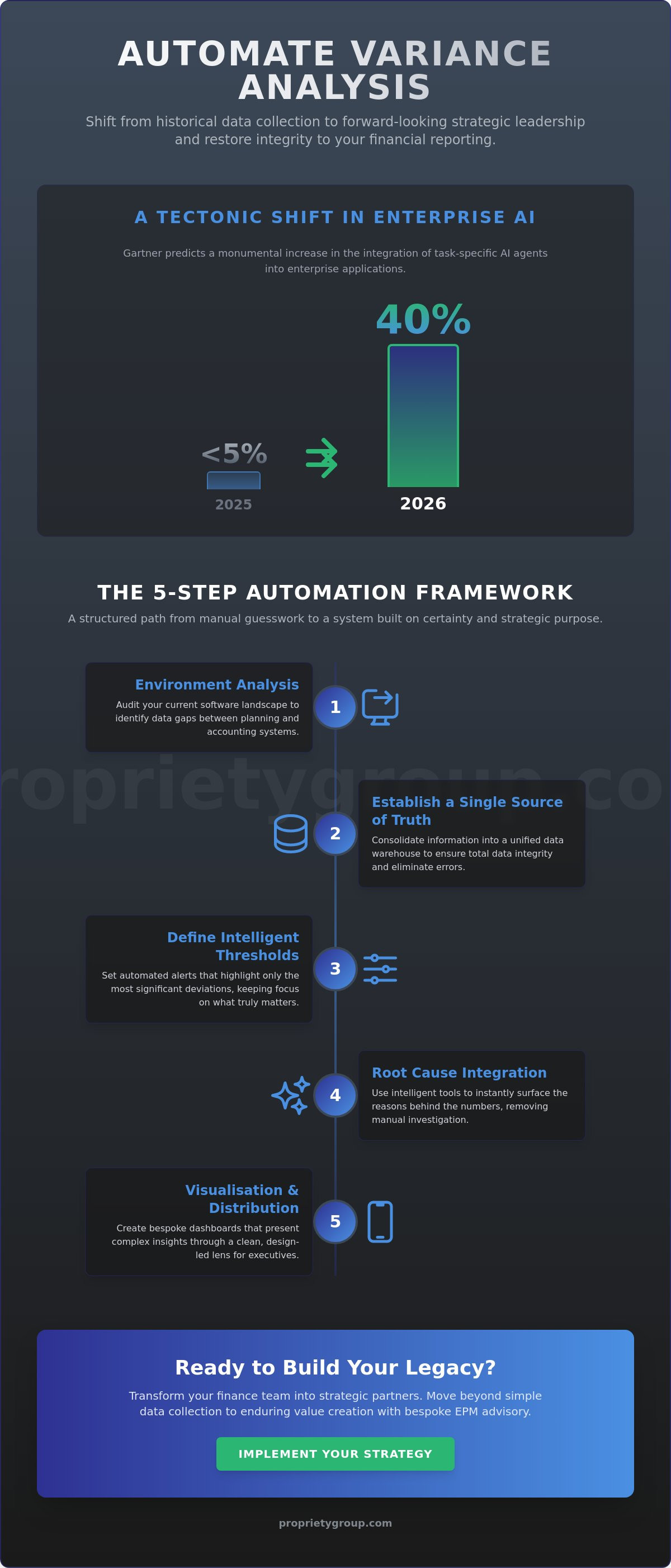
Gartner predicts that 40% of enterprise applications will integrate task-specific AI agents by the end of 2026; this is a staggering increase from the less than 5% adoption rate seen in 2025. You likely recognize the weight of this transition while managing the new IFRS 18 requirements that became effective on January 1, 2026. It's a common struggle for finance leaders who find their teams buried in meticulous manual data entry rather than providing the high-level advisory your organization requires. When a report takes weeks to finalize, the insights it offers are already history.
By automating variance analysis reporting, you can move beyond these retrospective hurdles and create a bespoke system that offers real-time visibility into performance gaps. We'll show you how to transform your financial reporting into a forward-looking strategic asset that uncovers the precise reasons behind every number. This guide outlines a scalable framework designed to restore integrity to your data and grant your team the time needed for visionary leadership. You'll learn how to implement intelligent automation that shifts the focus from simple data collection to enduring value creation.
Key Takeaways
- Shift your focus from historical data to future strategy by adopting a continuous approach to performance monitoring.
- Follow a meticulous 5-step framework for automating variance analysis reporting to ensure your financial insights are always relevant and actionable.
- Build a foundation of integrity by centralizing your data, creating a single source of truth that eliminates the risk of manual spreadsheet errors.
- Recognize why software is only one part of the solution and how a bespoke advisory approach aligns your tools with your long-term business legacy.
- Reclaim the capacity for your finance team to act as strategic partners, moving beyond data collection to focus on purposeful leadership and growth.
Beyond Manual Spreadsheets: The Strategic Case for Automating Variance Analysis Reporting
In a refined finance function, the traditional month-end scramble is being replaced by a continuous, software-led comparison of actual performance against forecasts. By automating variance analysis reporting, leaders ensure that every report reflects a standard of propriety. This transition replaces fragmented, disconnected data with a unified vision that balances corporate professionalism with meticulous precision, utilizing a clear framework for variance analysis to maintain total transparency.
Transitioning to real-time data feeds allows your team to move from a reactive posture to one of proactive planning. Instead of merely explaining why a gap occurred weeks ago, you can address shifts as they happen. This transformation turns financial reporting from a retrospective chore into a visionary asset that protects the legacy of your organization.
To better understand how modern tools simplify this transition, watch this helpful video:
The Cost of Manual Reporting Cycles
Manual reporting often suffers from "spreadsheet rot," where hidden errors in complex formulas compromise the integrity of your results. When reports take too long to produce, they arrive "dead on arrival," leaving leadership without the timely insights needed for confident decisions. This delay is particularly risky given the IFRS 18 standards that took effect on January 1, 2026, which demand more precise disaggregation of financial items and leave no room for manual oversight errors.
Predictive Intelligence vs. Historical Review
While traditional methods look backward, automating variance analysis reporting leverages AI in finance to create early warning systems. These tools don't just report what happened; they use predictive analytics to signal where performance might deviate in the future. This foresight allows you to act with quiet confidence, ensuring your strategic advisory remains a step ahead of market shifts while maintaining the highest ethical standards in data management.
How to Automate Your Variance Analysis Reporting: A 5-Step Framework
Achieving excellence in financial oversight requires a deliberate and steady progression. When you begin automating variance analysis reporting, you move from manual guesswork to a system built on certainty. This transformation follows a structured path that ensures every detail aligns with your strategic purpose.
- Step 1: Environment Analysis. Audit your current software landscape to identify where data gaps exist between your planning and accounting systems.
- Step 2: Establishing a Single Source of Truth. Consolidate your information into a unified repository to ensure total data integrity.
- Step 3: Defining Intelligent Thresholds. Set automated alerts that highlight only the most significant deviations, keeping your focus on what truly matters.
- Step 4: Root Cause Integration. Use intelligent tools to surface the reasons behind the numbers instantly, removing the need for manual investigation.
- Step 5: Visualisation and Distribution. Create bespoke dashboards that present complex insights through a clean, design-led lens for your executive team.
Building the Data Foundation
Success in automation is impossible without a solid base. A unified data warehouse serves as this anchor; it prevents the fragmentation that often plagues growing organizations. Meticulous data migration during this phase protects your historical legacy and ensures that your new system operates with absolute propriety. If you're ready to refine your infrastructure, our team offers specialized implementation services to guide your journey.
Designing for Decision-Making
A report is only valuable if it inspires correct action. By following AACE International's guide to variance analysis, you can structure your reports to be more than just simple data dumps. We recommend integrating a Management Actions Library to provide pre-defined responses to specific performance gaps. This approach ensures that your reporting remains authoritative and helpful, turning every insight into a clear path forward for the business.
Implementing Your Automation Strategy with EPM Advisory
A software installation is rarely a silver bullet. While modern tools offer impressive processing power, they often lack the principled vision needed to reflect your organization's specific operational nuances. Automating variance analysis reporting is most effective when it's guided by an expert-led narrative that bridges the gap between raw data and strategic execution. This is where EPM advisory becomes essential. It ensures that your technology serves a higher business purpose rather than just performing isolated calculations.
At Propriety Group, we help CFOs navigate the financial close process with greater efficiency and quiet confidence. By integrating intelligent automation into your existing ecosystem, we remove the friction that often delays critical insights. To maintain this level of excellence, our PG Care model offers a bespoke support structure for ongoing system optimization and user training. This steady, measured approach ensures your reporting framework remains a permanent asset that evolves with your business.
Choosing the Right Platform for Your Legacy
Selecting from various EPM platforms requires a meticulous eye for detail. For complex multi-currency or multi-entity organizations, a standard setup is rarely sufficient. Bespoke configuration is vital to ensure that your automated reports adhere to variance analysis best practices while respecting the unique logic of your global operations. This precision protects the integrity of your data and reinforces the trust your partners place in your financial leadership.
Empowering the Finance Team
Automation liberates your team from the repetitive role of data collection. When you remove the burden of manual reconciliation, your staff can finally step into their roles as strategic business partners. This shift isn't just about speed; it's about the intersection of people and purpose. With professional guidance, your reporting system becomes a visionary tool that supports long-term growth and secures your company's legacy for years to come.
Securing Your Financial Legacy Through Intelligent Automation
The journey toward financial excellence begins with a commitment to integrity and precision. By automating variance analysis reporting, you move your finance team away from the burden of manual reconciliations and toward a role of strategic advisory. You've seen how a meticulous 5-step framework and a unified data foundation can protect your organization's legacy while providing the real-time visibility needed for confident leadership. This transition is about more than just speed; it's about ensuring every report meets a standard of propriety and correctness.
Since 2019, Propriety Group has functioned as a discerning partner for finance leaders, offering a visionary, design-led approach to financial architecture. Our expertise ensures that your systems aren't just functional but are bespoke reflections of your business purpose. Through our dedicated PG Care managed support model, we provide the long-term security and steady optimization required to navigate an evolving regulatory landscape. We're here to help you bridge the gap between complex data and clear, purposeful action.
Explore our EPM Advisory services and start your transformation today. We invite you to build a reporting framework that reflects the true standard and excellence of your organization.
Frequently Asked Questions
What are the primary benefits of automating variance analysis reporting for large organisations?
The primary benefit is the immediate reclamation of capacity for strategic advisory work. By removing the burden of manual reconciliations, organisations often see a 90% reduction in data entry errors. This meticulous approach ensures that your financial reports maintain absolute integrity. It allows leaders to focus on the long-term legacy of the business rather than getting lost in the granular details of data collection.
Can automated variance analysis handle qualitative data or "soft" reasons for budget misses?
Modern systems capture qualitative insights by allowing team members to attach bespoke commentary directly to performance gaps. When automating variance analysis reporting, you can integrate "soft" reasons like market sentiment or internal shifts into the digital record. This creates a more thorough narrative that explains the reasons behind the numbers, ensuring that every report remains a principled and visionary tool for decision-making.
How long does it typically take to implement an automated variance reporting system?
A standard implementation cycle typically spans between 90 and 180 days. This period allows for a meticulous audit of your current data landscape and the careful migration of historical records. The process is measured and steady, ensuring that the final system is tailored to your organisation's unique purpose. We prioritise a steady flow from strategic concept to execution to ensure your team feels confident in the new framework.
Do I need to replace my existing ERP to automate my variance analysis reporting?
You don't need to replace your current ERP to begin automating variance analysis reporting. Most modern performance management solutions are designed to act as a sophisticated layer that sits on top of your existing infrastructure. These tools connect directly to your current systems to pull data automatically; this preserves your previous technology investments while adding a new level of visionary intelligence to your finance function.