

A software rollout is often viewed as a technical hurdle, but the most successful organizations treat it as a deliberate act of craftsmanship that defines their long-term legacy. You likely feel the weight of fragmented reporting and the persistent anxiety that a single data migration error could disrupt your entire operation. It's natural to worry about system downtime when your team is already stretched thin by reactive planning. This guide provides a comprehensive epm implementation project plan template designed to transform your financial architecture into a single source of truth. By following a structured, expert-led framework, you can ensure your EPM implementation delivers enduring value rather than temporary relief. We'll explore how to integrate predictive AI capabilities and automated forecasting while maintaining the highest standards of precision and team stability. Let's examine the specific milestones required to move from fragmented data to a sophisticated, visionary financial strategy. To begin your own transformation, book a call with our team today.
Key Takeaways
- Understand how to transition from fragmented, reactive reporting to a unified architecture that serves as a single source of truth for your organization.
- Learn to utilize a professional epm implementation project plan template to bridge the gap between visionary financial strategy and granular technical execution.
- Gain insights into mapping your organization's unique financial logic during the design phase to ensure your new platform delivers maximum precision.
- Discover why the go-live date is merely the starting point for a continuous journey of optimization and long-term system health.
- Master the art of balancing human intentionality with automated forecasting to create enduring value, and book a call with our team to start your journey.
The Foundation of a Strategic EPM Implementation
An EPM implementation represents a fundamental shift in how an organization perceives its own performance. It is the deliberate process of replacing fragmented, manual reporting with a unified and forward-looking system. This transformation is often categorized under the broader discipline of Business Performance Management (BPM), which focuses on the alignment of strategic goals with operational outcomes. By centralizing data, leaders gain the clarity needed to move from a defensive, reactive posture to one of proactive growth.
Building this bridge requires more than just software. It demands a structured epm implementation project plan template that translates high-level visionary goals into granular, actionable tasks. A critical early step involves a thorough environment analysis. This ensures the new system fits your unique financial architecture and respects the existing nuances of your business logic. To better understand how to structure your transition, watch this helpful video on creating an effective implementation plan:
For the CFO, this initiative is the primary vehicle for establishing a single source of truth for finance. It eliminates the discrepancies that arise when different departments rely on disconnected spreadsheets. When every stakeholder looks at the same verified data, the organization gains a level of certainty that is essential for long-term security.
Aligning Stakeholders and Defining Intent
A finance-led implementation requires a diverse team that spans from executive sponsors to daily end-users. Early in the planning phase, it's vital to establish standards of correctness for data quality and reporting. This ensures that the system's output is trusted across the entire company. Engaging in EPM advisory during these initial stages helps bridge the gap between technical software features and your specific business objectives. It ensures that every configuration choice serves a clear purpose, creating a foundation that supports both human intentionality and technical precision.
The EPM Implementation Project Plan Template
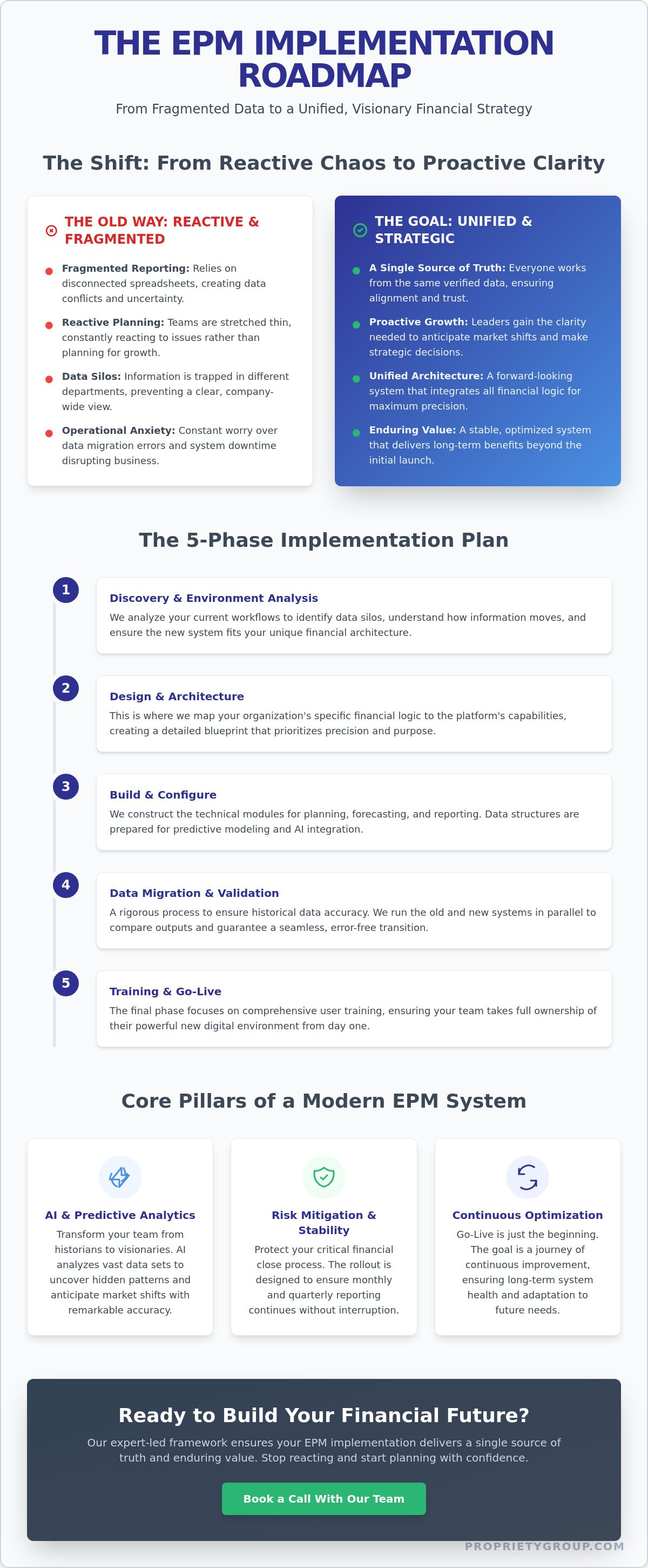
Executing a financial transformation requires a roadmap that respects the complexity of your data while providing a clear path forward. A structured epm implementation project plan template allows leaders to move through five distinct stages of growth with quiet confidence. This measured approach ensures that every technical decision aligns with your overarching business goals.
Phase 1 begins with discovery and environment analysis. We look deep into your current workflows to identify where data silos exist and how information moves through your organization. Phase 2 moves into design and architecture. This is where we map your unique financial logic to the platform's capabilities, creating a blueprint that prioritizes precision. In Phase 3, we build and configure the technical modules for planning and forecasting. Phase 4 focuses on data migration and validation, which is a rigorous process of ensuring historical accuracy. Finally, Phase 5 centers on user training and the go-live event, where your team takes ownership of their new digital environment.
Integrating AI and Predictive Analytics
Modern planning thrives on foresight rather than hindsight. A sophisticated epm implementation project plan template must include a dedicated milestone for financial AI solutions. During the build phase, we prepare your data structures specifically for predictive modeling. This preparation allows the system to analyze vast amounts of information to find patterns that human eyes might miss. It transforms your finance team from historians into visionaries who can anticipate market shifts with remarkable accuracy.
Risk Mitigation and Change Management
Transitioning to a new system shouldn't jeopardize your existing responsibilities. We carefully design the rollout to protect your financial close process, ensuring that monthly and quarterly reporting remains uninterrupted. A vital step in this strategy is the parallel run. We operate the old and new systems simultaneously to compare every calculation. This rigorous comparison confirms that the new architecture delivers total precision before you fully commit to the switch. If you're ready to build a more resilient financial future, speak with one of our advisors to begin your journey.
Post-Implementation: Ensuring Enduring Value
Many leaders mistake the launch date for the finish line. In reality, a successful epm implementation project plan template treats the "Go-Live" event as the beginning of a continuous journey toward operational excellence. Your business strategy will inevitably evolve as markets shift. Your financial architecture must be flexible enough to adapt alongside those changes without losing its structural integrity.
Maintaining a sophisticated system requires more than occasional troubleshooting. It demands a commitment to regular system reviews that align your technical capabilities with your latest strategic goals. This proactive approach prevents the system from becoming a static archive of past processes. Instead, it remains a dynamic tool that empowers your finance team to stay agile and responsive in an unpredictable economic landscape. Ongoing advisory serves as a compass, ensuring your technology always supports your long-term vision.
The PG Care Model for Continuous Support
Our PG CARE - EPM Solution Support provides a dedicated partner for technical assistance and essential system updates. This subscription-based model ensures that your environment remains healthy and optimized for performance. We also prioritize recurring training sessions to prevent "knowledge drift" within your finance team. When new members join or roles change, these sessions ensure that every user maintains a high level of proficiency, preserving the standards of correctness established during the initial build.
Transitioning to Business-as-Usual
The hand-over from the project team to the operational team is a critical milestone. We define success through clear criteria, ensuring your staff feels fully empowered to manage the platform independently. This transition is about more than technical competence; it's about fostering a culture of intentionality. When your team uses the system to drive specific management actions, the software becomes a cornerstone of your organizational identity. It stops being a new tool and starts being the engine of your success. To secure the long-term health of your financial transformation, book a call with our team today.
Architecting a Legacy of Financial Precision
Transitioning to a unified financial environment is a significant undertaking that requires both technical precision and strategic vision. You've learned that a successful rollout depends on aligning stakeholders early and maintaining a rigorous focus on data integrity. By utilizing a professional epm implementation project plan template, you can navigate the complexities of discovery, design, and deployment without compromising your daily operations. This structured approach ensures that your new system provides a single source of truth that grows alongside your organization's ambitions. It's a commitment to excellence.
Since our founding in 2019, our boutique consultancy has specialized in the art of connecting ERP, EPM, and CRM solutions into a seamless architecture. We bring deep expertise in AI and predictive financial analytics to help you move beyond historical reporting into a future of proactive insight. We view every implementation as an opportunity to create enduring value through craftsmanship and intentionality. To begin architecting your organization's transformation, book a call with our expert team to discuss your EPM implementation strategy. Your journey toward a more resilient and visionary finance function starts here.
Frequently Asked Questions
How long does a typical EPM implementation project take?
A typical implementation usually spans three to nine months. The exact duration depends on the complexity of your financial architecture and the specific modules you choose to deploy. While smaller organizations might complete the process faster, larger enterprises with intricate data integrations require a more measured pace. It's vital to prioritize a thorough setup over a rushed launch to ensure the system delivers enduring value.
What are the most common risks in an EPM project plan and how can we avoid them?
The most frequent risks include scope creep and poor data quality. You can mitigate these challenges by strictly following a professional epm implementation project plan template that defines clear milestones and boundaries. Another significant risk is low user adoption. Engaging in expert advisory early in the process helps align the new technology with your team's actual needs, ensuring they feel confident using the system.
Do we need to clean our data before starting the implementation process?
You should prioritize data cleansing before the technical build phase begins. High-quality data is the foundation of any successful system, and migrating incorrect information only replicates existing problems in a more expensive environment. Taking the time to validate your historical records ensures your new platform provides a single source of truth. This preparatory work is essential for achieving the precision your leadership team expects.
What is the difference between a project plan and an implementation plan?
A project plan outlines the broad strategic goals, resource allocations, and high-level timelines for the entire transformation. An implementation plan is a more granular document that focuses on the specific technical steps required to configure the software. Both elements are necessary components of a comprehensive epm implementation project plan template. One provides the visionary direction while the other details the tactical execution needed to reach your goals.
To ensure your financial transformation is handled with the highest standards of precision and care, book a call with our team today.