
AI in Finance: A Visionary Guide to Predictive Intelligence and Strategic Growth

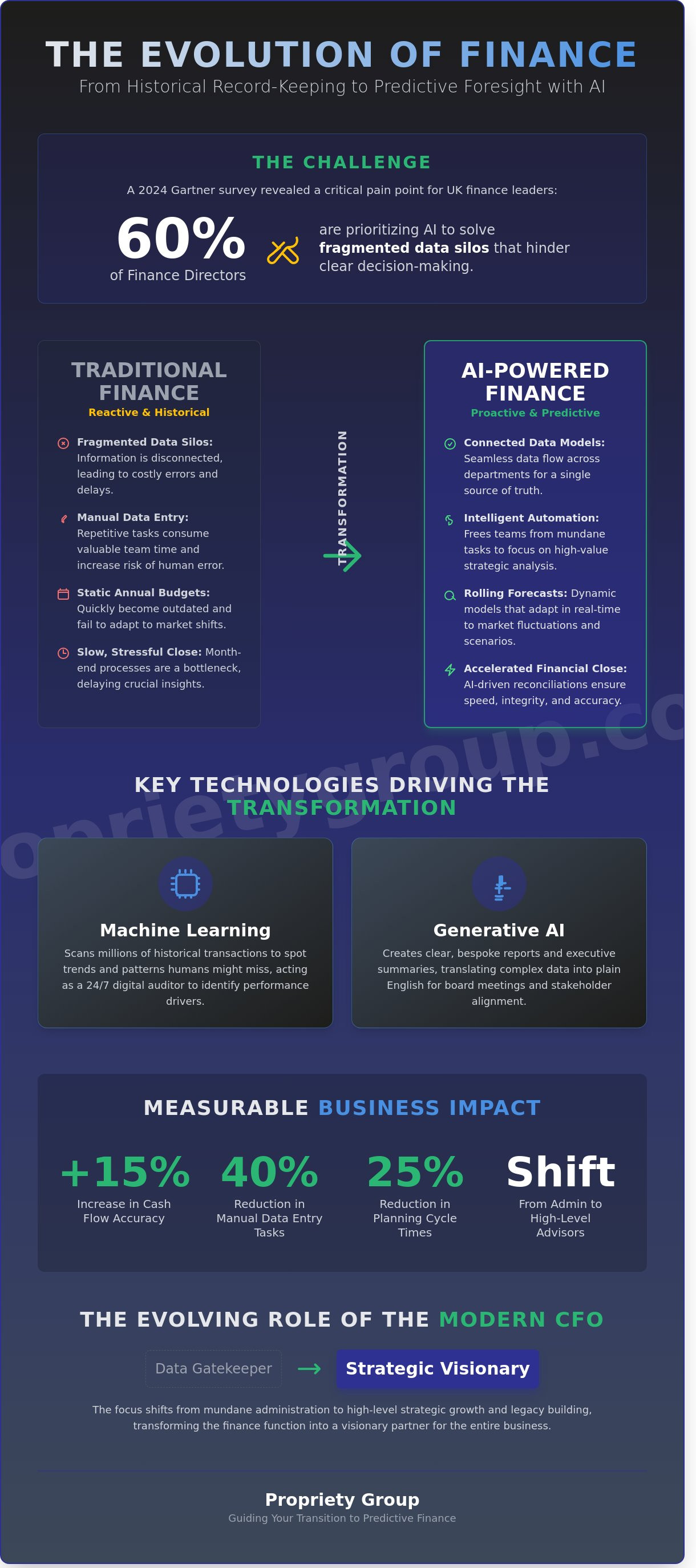
What if the most significant asset in your organisation wasn't the capital you hold, but your ability to predict market shifts before they occur? For many leaders across the United Kingdom, the integration of ai in finance represents a transition from recording historical data to crafting a legacy through foresight. You've likely experienced the frustration of managing fragmented information; a 2024 Gartner survey revealed that 60% of finance directors are now prioritising AI to solve the data silos that hinder clear decision making. It's a challenge that requires a refined approach to ensure your firm remains both agile and authoritative.
We understand that technology can often feel like an unexplainable black box, yet true propriety in business requires a meticulous approach to innovation. This guide promises to demystify these tools, offering a bespoke roadmap that transforms your reporting into a predictive engine for strategic growth. We'll explore how to improve forecasting accuracy and empower your team to act as high-level advisors who focus on purpose rather than just processing. You'll gain the clarity needed to move beyond reactive reporting and lead your organisation with quiet confidence.
Key Takeaways
- Understand how the finance function is moving beyond simple record-keeping to embrace a sophisticated system of foresight that anticipates future market shifts.
- Learn how to integrate advanced intelligence into your planning and budgeting cycles to ensure your organisation maintains a resilient and healthy cash flow.
- Discover how the strategic application of ai in finance can turn vast amounts of information into clear, actionable insights that support long-term strategic growth.
- Explore the necessity of meticulous data management to ensure your digital tools remain fair, accurate, and worthy of your complete trust.
- Gain a clear, principled roadmap for adopting new technologies that uphold the highest standards of integrity and professional excellence.
What is AI in Finance? Defining the Modern Standard
The definition of ai in finance has evolved from basic spreadsheet automation into a sophisticated system of cognitive intelligence. Traditional systems recorded history; modern AI anticipates the future. This transition represents a fundamental change in how UK businesses manage capital and risk. By integrating these tools, firms move beyond simply tracking expenses to understanding the underlying forces that drive market shifts. The foundation of this progress lies in Financial Technology (Fintech), which provides the infrastructure for real-time decision-making.
To gain a deeper understanding of how these systems are reshaping the industry, watch this expert overview:
Predictive foresight is now the baseline for leadership. A 2023 study found that 60% of finance directors in the UK are prioritising automated intelligence to combat economic uncertainty. Instead of looking at last month's performance, leaders use connected finance models to simulate potential outcomes before they occur. This connected model ensures that data flows seamlessly across departments, removing the silos that often lead to costly errors and ensuring meticulous accuracy in reporting.
Technologies Powering Financial Transformation
- Machine learning: This tool scans millions of historical transactions to spot trends that humans might miss. It's a digital auditor that works 24 hours a day to identify patterns in performance.
- Generative AI: This creates clear, bespoke reports and executive summaries. It translates complex data into plain English for board meetings, ensuring every stakeholder understands the strategy without needing a technical background.
Why AI is No Longer Optional for the Strategic CFO
Modern CFOs face a landscape defined by rapid shifts. Meeting the board's demand for forward-looking assertions requires more than traditional methods can provide. In the UK market, where interest rates and inflation have seen significant movement since 2022, real-time data processing is vital for maintaining fiscal integrity.
Automating repetitive data collation addresses the current talent gap effectively. Early adopters in the FTSE 100 have reported a 40% reduction in manual data entry tasks. This allows the finance function to shift its focus from mundane administration to high-level strategic growth and legacy building. It's a move from being a gatekeeper of data to a visionary partner in the business.
The Architecture of AI-Driven Enterprise Performance Management
Modern enterprise performance management (EPM) relies on a foundation of precision. By embedding ai in finance across the planning cycle, organisations move from reactive reporting to predictive intelligence. This shift allows for a 15% increase in cash flow accuracy by identifying payment behaviour before it affects the balance sheet. This structural change requires a meticulous alignment of new models with existing legacy data to ensure every insight maintains its integrity. Integrating these systems isn't just a technical task; it's a strategic alignment of people and purpose. Teams must verify that data flowing from the warehouse to the dashboard is clean and reliable.
Revolutionising FP&A with Predictive Modelling
Traditional budgets often expire the moment they're signed. AI introduces rolling forecasts that adapt to market shifts in real time. This automation handles variance analysis in seconds, pinpointing exactly why a department overspent by £5,000 without manual digging. It's particularly effective for scenario modelling for opex and headcount; ensuring that growth remains sustainable. Leaders who engage with EPM advisory services often see a 25% reduction in planning cycles within the first year. These predictive tools allow for a more agile response to UK market fluctuations, turning data into a permanent asset.
AI in Financial Close and Consolidation
The month-end close shouldn't be a period of stress. Using ai in finance to manage reconciliations ensures that the final figures are beyond reproach. Automation now handles intercompany reconciliations and journal entries with absolute consistency. Real-time anomaly detection flags errors as they occur, which protects the company's financial reputation. This level of control aligns with the standards discussed in the GAO report on AI oversight, which emphasises the need for robust governance in automated systems. By removing the burden of repetitive tasks, the finance team can focus on high-value strategy. If you're looking to refine your internal structures, you might explore our approach to strategic growth.
Implementing AI with Integrity: Governance and Roadmap
Trust is the most valuable currency in the financial sector. When we discuss ai in finance, we aren't just talking about speed; we're discussing the preservation of reputation and the creation of a lasting legacy. For a CFO to act on a machine's prediction, the logic behind that output must be transparent. This clarity prevents the "black box" effect where decisions are made without a verifiable trail, ensuring that every strategic move remains grounded in reason.
Meticulous data governance serves as the primary safeguard against error. By ensuring that information is clean and representative, firms prevent the subtle creep of algorithmic prejudice. A vital step for any visionary leader is understanding and mitigating bias in AI to protect the integrity of the firm. According to the UK Government’s March 2023 AI regulation white paper, transparency and accountability are the essential pillars for high-stakes financial operations.
The Human-in-the-Loop Model
AI should serve as a sophisticated lens that augments, rather than replaces, the seasoned judgment of a professional CFO. Human intuition remains the final filter for every major decision. Finance teams must be organised to act as ultimate validators, checking machine outputs against real-world economic shifts. Building a single source of truth is the only way to feed these algorithms effectively, as fragmented data leads to fragmented strategy.
A Strategic Framework for Adoption
Implementing ai in finance requires a measured, three-step journey that prioritises precision over haste:
- Step 1: Environment Analysis. Assess your current data maturity to ensure your infrastructure can support advanced tools.
- Step 2: Define High-Impact Use Cases. Focus on specific areas like cash flow forecasting, which has been shown to improve accuracy by 25% in UK mid-market firms.
- Step 3: Select a Bespoke Partner. Choose a collaborator who understands the specific nuances of the UK market and provides ongoing support rather than a one-size-fits-all solution.
By following this structured path, leaders can ensure that their technological evolution is both ethical and effective. This purpose-led implementation creates a foundation for growth that is not only profitable but also principled.
Securing Your Financial Legacy Through Intelligent Design
The shift toward ai in finance represents more than a technological upgrade; it's a fundamental reimagining of how UK firms protect and grow their capital. By integrating predictive intelligence into enterprise planning, leaders move from reactive reporting to proactive strategy. Success depends on a roadmap built with integrity, ensuring every automated decision aligns with the high standards of correctness your legacy demands. The Bank of England’s 2022 survey confirms that 72% of UK financial firms already use machine learning to enhance operational resilience and efficiency.
Propriety Group brings a visionary approach to this transition. Our finance transformation experts provide strategic advisory that simplifies complex data into clear, actionable paths. We specialise in bespoke EPM implementation, ensuring your systems are as refined as your business goals. Through our meticulous PG Care support model, we offer long-term security and continuous refinement for your digital infrastructure. It's time to transform your data into an enduring asset that serves your long-term purpose.
Discover how our bespoke AI solutions can elevate your finance function.
Your journey toward a more resilient and precise financial future starts today.
Frequently Asked Questions
How is AI currently being used in corporate finance departments?
Corporate finance teams use AI to automate repetitive tasks like data entry, invoice matching, and bank reconciliations. A 2023 Gartner report shows that 80% of finance leaders now use these tools to handle high-volume transactions. This shift allows staff to focus on higher-level analysis. By streamlining these processes, UK firms save an average of 400 hours of manual labour per year, ensuring that records remain precise and up to date.
What are the primary benefits of implementing AI in financial planning?
The main benefits of using ai in finance include improved forecasting accuracy and the ability to process vast amounts of data instantly. A 2023 study by PwC found that AI-driven models reduce errors in financial predictions by 20%. This precision helps businesses allocate capital more effectively. Leaders gain a clearer view of future cash flows, which is vital for maintaining long-term stability and making informed investment decisions in the UK market.
Can AI replace the role of the CFO or finance manager?
AI won't replace the CFO or finance manager because these roles require human judgement and ethical oversight that machines can't replicate. A 2024 Deloitte report found that while AI can manage 40% of routine accounting tasks, the demand for human strategic leadership has risen by 15%. Professionals use these insights to guide the company's vision. The human element remains essential for navigating complex regulations and building trust with stakeholders.
What are the biggest challenges when adopting AI in finance?
The most significant hurdles include poor data quality and the initial investment required for setup. Research from the University of Cambridge in 2023 noted that 65% of UK businesses struggle with disconnected data systems. Implementation costs for these advanced platforms often begin at £50,000 for mid-sized firms. Overcoming these obstacles requires a meticulous approach to data management and a clear understanding of the long-term value these tools provide to the organisation.