

What if the persistent exhaustion within your finance department isn't a seasonal hurdle, but a symptom of a structural deficit in your operational architecture? You likely see your most skilled FP&A talent buried under manual data reconciliation and the frantic firefighting of the month-end close. It's a burden that leads to high attrition and a loss of institutional knowledge. By focusing on improving finance team productivity through sophisticated planning technology, you can shift the narrative from mere survival to strategic excellence.
This article provides a refined framework for CFOs who wish to replace manual processes with precise, automated forecasting tools. We'll explore how a more intentional approach to technology creates a sustainable reporting cycle and reduces manual errors. You'll learn how to protect your senior staff by removing the friction of outdated workflows. Our goal is to help you build a finance function that reflects a commitment to quality and long-term security. We'll move from high-level strategy to the practical details of creating an environment where talent can thrive and produce enduring value.
Key Takeaways
- Identify the critical distinction between temporary peak-season stress and the chronic, structural burnout caused by fragmented financial systems.
- Learn how improving finance team productivity requires a strategic shift from manual data reconciliation to sophisticated, automated planning technology.
- Establish a single source of truth to eliminate the month-end bottleneck, allowing your senior staff to focus on high-value strategic insights rather than repetitive data entry.
- Discover how integrating Financial AI Solutions can serve as a digital teammate, handling predictive heavy lifting and reducing the time spent on manual validation.
- Create a sustainable reporting environment that secures the long-term retention of top-tier talent by aligning operational efficiency with human experience.
Addressing the Structural Causes of Finance Team Burnout
Burnout in the finance sector is often misunderstood. Many leaders view it as a temporary side effect of the audit season or year-end reporting. True structural burnout is a deeper phenomenon. It stems from a misalignment between human potential and technical limitations. By understanding occupational burnout as a systemic issue rather than an individual failing, CFOs can begin the work of improving finance team productivity through better design.
The "Manual Labour Trap" occurs when fragmented ERP systems force senior professionals into a cycle of late-night reconciliations. This isn't just about hard work; it's about the psychological weight of "Data Anxiety." When your team doesn't trust the figures they produce, every report becomes a source of stress. Integrating Financial AI Solutions can help break this cycle by automating the mundane, allowing for more intentionality in high-level decision making.
To better understand how technology influences these dynamics, watch this helpful video:
The Hidden Cost of Fragmented Reporting
Manual data entry creates a repetitive cycle of errors and corrections that quickly exhausts senior talent. When staff maintain "shadow accounting" spreadsheets just to verify the main system, morale drops. This duplication of effort signals a lack of confidence in leadership's chosen tools, making it impossible to achieve high standards of correctness. It's a waste of the very expertise you hired them for.
Why Wellbeing Apps Often Fail to Fix Productivity
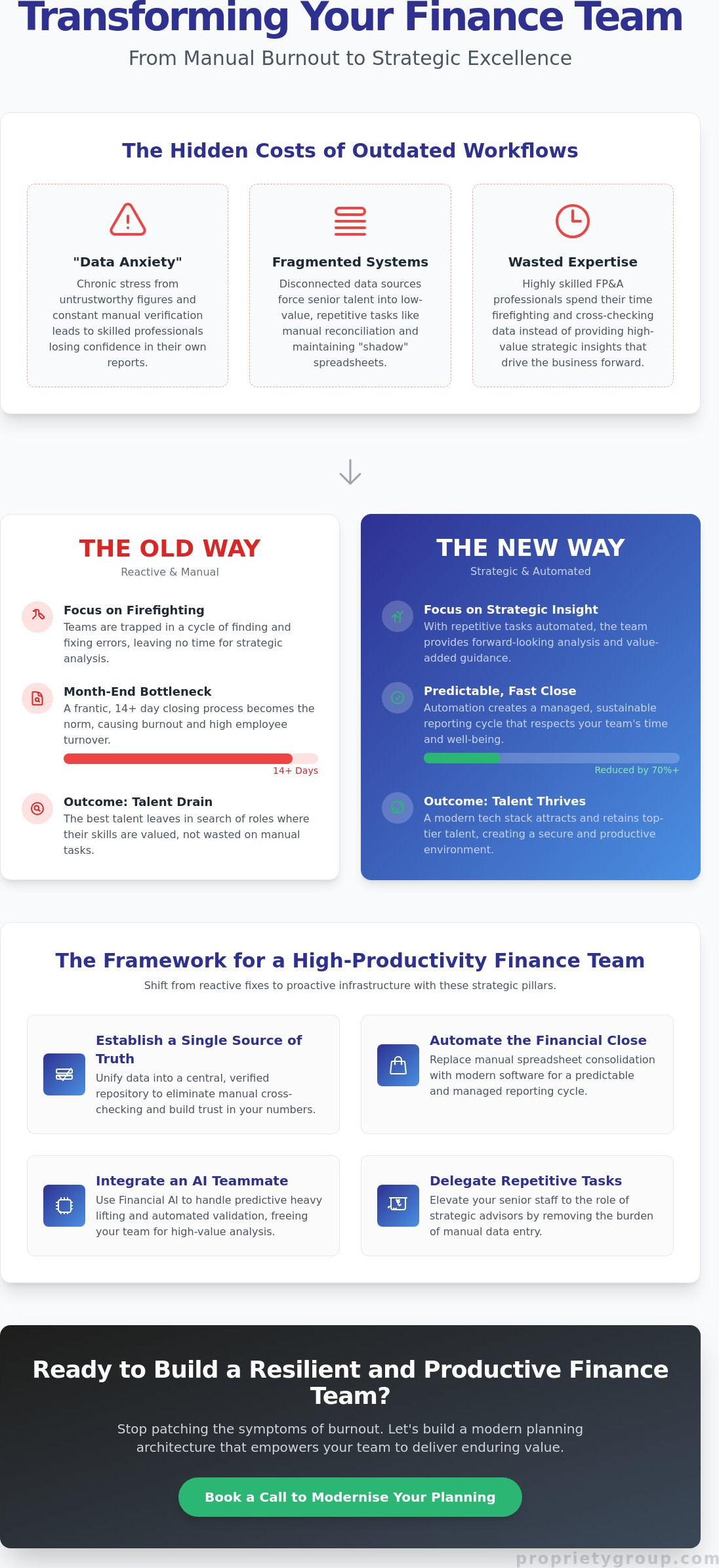
Corporate wellness initiatives like gym memberships or yoga sessions are well-intentioned, but they don't address the root cause of a 14-day month-end close. A team that's consistently firefighting doesn't need more stretching; they need better systems. Improving finance team productivity requires a shift from reactive fixes to proactive infrastructure. A supportive culture cannot survive an unsupportive technical infrastructure.
Strategic Frameworks for Improving Finance Team Productivity
True transformation begins by dismantling the silos that keep your team anchored to their desks. Establishing a Single Source of Truth isn't just a technical objective; it's a prerequisite for team stability. When data flows from a central, verified repository, the constant need for manual cross-checking evaporates. This foundation allows leadership to transition toward exception-based management through professional EPM Advisory, where senior staff only intervene when figures deviate from specific benchmarks.
Delegating repetitive, low-value tasks to automated systems is essential for improving finance team productivity. By removing the burden of manual data entry, you elevate your senior staff to the role of strategic advisors. Insights into AI and automation in finance indicate that these technologies are the cornerstone of modern efficiency, allowing teams to prioritise foresight over historical recording. If you're looking to refine your department's output, you might consider how to modernise your planning architecture.
Automating the Financial Close Process
Traditional month-end cycles often feel like a race against time. Modern planning software removes the need for manual spreadsheet consolidation, which is frequently the primary source of error. Establishing automated intercompany reconciliations significantly reduces the pressure on your team, turning a frantic fortnight into a predictable and managed process. It's about creating a reporting cycle that respects the human experience.
Driver-Based Planning as a Productivity Tool
Moving away from static, annual budgets toward rolling forecasts creates a more rhythmic and manageable workload throughout the year. Driver-based models allow for rapid scenario testing without the need for manual rebuilds of complex models. This approach ensures that improving finance team productivity becomes a permanent feature of your department's culture, smoothing out the intense peaks that typically lead to burnout.
Future-Proofing Performance with AI and Managed Support
The transition from manual frameworks to a future-proofed environment requires a shift in how we perceive the relationship between humans and machines. Integrating Financial AI Solutions transforms technology from a simple tool into a digital teammate. This partnership is vital for improving finance team productivity. AI-driven anomaly detection identifies discrepancies in real-time; this reduces the exhausting hours senior leaders spend on manual audit and validation.
To ensure these systems remain precise without taxing your internal resources, our PG CARE - EPM Solution Support model provides a managed path to excellence. It's an investment in permanence and precision that allows your staff to focus on high-level strategy rather than system maintenance. This approach ensures that your technical infrastructure remains as sophisticated as the talent it supports.
Predictive Intelligence vs. Reactive Firefighting
AI allows teams to see around the corner. By identifying trends before they manifest as crises, your department moves from reactive firefighting to predictive foresight. This shift drastically reduces the psychological stress of unexpected financial shocks. We invite you to explore our full guide on AI in Finance to understand the broader significance of this transition and how it fosters strategic growth.
The Role of Managed Support in Team Empowerment
A dedicated support partner prevents the slow decay of system utility. Without regular updates and training, even the best software becomes a source of frustration. Ongoing education ensures your team feels competent and empowered. This alignment of human experience and technical intentionality is key to improving finance team productivity over the long term. A visionary CFO views sophisticated technology as the ultimate tool for talent retention and institutional stability. It's about creating an environment where excellence is the standard, not the exception.
To discuss how these strategic frameworks can be implemented within your organisation to protect your talent and enhance performance, book a call with our team today.
Transforming Strategy into Sustainable Growth
The path to a resilient finance department requires more than just harder work; it demands a fundamental redesign of how data and talent intersect. By moving away from fragmented, manual processes and embracing a unified technical architecture, you protect your most valuable asset: your people. This strategic shift ensures that your reporting cycles remain predictable and your senior staff stay focused on the visionary insights that drive the business forward. It's about creating a workspace where precision and human experience are finally in alignment.
Since 2019, we've acted as specialist partners in EPM and CRM implementation, providing the expertise needed for improving finance team productivity through precise, automated solutions. Our approach combines a visionary focus on AI for FP&A with the reliability of our PG Care managed support model to guarantee your systems remain healthy and effective. It's time to transition from the exhaustion of the manual close to the quiet confidence of a truly modern finance function.
Book a call with our advisory team to discuss your finance transformation and begin the journey toward a more sustainable and high-performing future for your organisation.
Frequently Asked Questions
What are the first signs of structural burnout in a finance team?
Structural burnout often manifests as a persistent reliance on late-night shifts and a noticeable decline in the quality of strategic analysis. You'll see high attrition rates among your most skilled talent, as they grow weary of repetitive manual data reconciliation. This isn't just about workload; it's about the psychological toll of a fragmented infrastructure that prevents your staff from performing the high-level work they were hired to do.
How does automating the financial close process reduce team stress?
Automating the financial close eliminates the manual spreadsheet consolidation that typically causes the most errors and delays. By establishing a single source of truth, you remove the constant need for cross-checking and validation. This shift is essential for improving finance team productivity, as it turns a chaotic month-end cycle into a predictable, manageable process that respects your team's time and expertise.
Can AI really help in preventing burnout for senior finance leaders?
AI acts as a digital teammate by managing the data-heavy tasks that often lead to executive exhaustion. Through real-time anomaly detection and predictive intelligence, AI reduces the time senior leaders spend on manual audit and validation. This allows them to focus on enterprise strategy rather than data entry, ensuring long-term security and a sense of professional fulfilment within the leadership team.
Is it better to hire more staff or invest in planning and forecasting software to stop burnout?
Investing in sophisticated planning and forecasting software is generally more effective than increasing headcount to manage a broken system. Adding more staff to a manual environment often increases complexity without solving the root cause of the friction. By improving finance team productivity through better technology, you create a scalable foundation that allows your existing team to thrive and produce enduring value for the organisation.